

How Can Plasma-Activated Water Help Agriculture Reduce the Carbon Footprint of Fertilizer Use and Transportation?
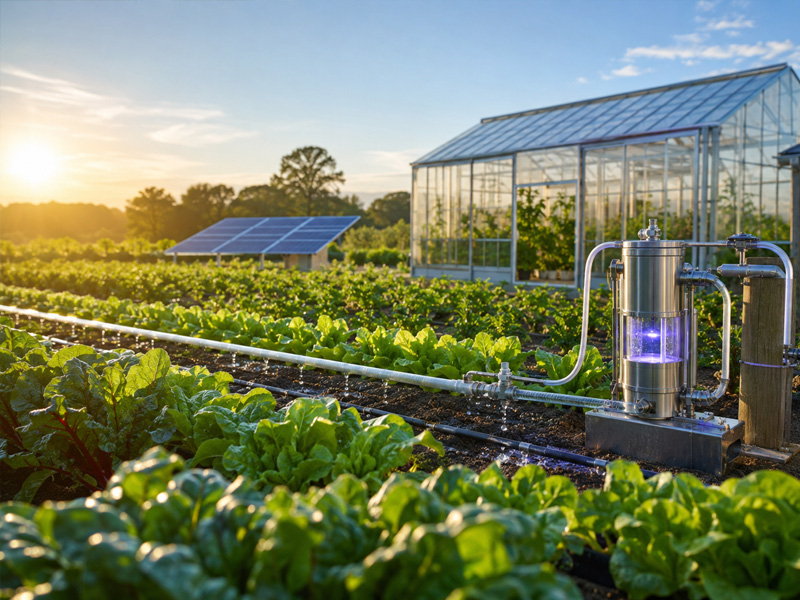
Modern agriculture relies heavily on nitrogen fertilizers. However, their environmental impact extends beyond the application stage to include carbon emissions from raw material extraction, industrial production, packaging, storage, and long-distance transportation.
According to the International Energy Agency, conventional ammonia production depends heavily on natural gas and coal and accounts for approximately 2% of global final energy consumption. Producing plant-available reactive nitrogen on site at farms or greenhouses using air, water, and electricity could therefore shorten fertilizer supply chains and create a new pathway for agricultural carbon reduction. Read the IEA’s Ammonia Technology Roadmap
What Is Plasma-Activated Water?
Plasma-activated water (PAW) is produced by bringing atmospheric-pressure plasma into contact with air and water. The plasma creates a high-energy reaction environment involving atmospheric nitrogen and oxygen, generating various reactive oxygen and nitrogen species that subsequently dissolve in the water.
These species may include:
- Nitrate (NO₃⁻)
- Nitrite (NO₂⁻)
- Hydrogen peroxide (H₂O₂)
- Other short-lived reactive species
Nitrate is one form of nitrogen that plants can absorb and use. By appropriately controlling plasma power, treatment time, gas–liquid contact, and water quality, the composition and concentration of reactive species can be adjusted for different agricultural needs.
Studies suggest that appropriately concentrated PAW may promote seedling growth and chlorophyll formation in certain crops. Excessive concentrations, however, may inhibit plant growth. Operating parameters must therefore be established according to the crop, growth stage, and cultivation conditions. See the lettuce study published in Scientific Reports
How Can On-Site Nitrogen Fixation Reduce Agriculture’s Carbon Footprint?
1. Reducing Reliance on Conventional Nitrogen Fertilizers
Conventional nitrogen fertilizers are generally produced in centralized chemical plants through energy-intensive processes. PAW can use air, water, and electricity to produce reactive nitrogen directly at the point of use. If it replaces part of the conventional fertilizer input, it may reduce emissions associated with upstream nitrogen fertilizer production.
The objective is not to claim that PAW can completely replace all fertilizers. Its potential contribution should instead be evaluated according to the crop’s actual nitrogen requirements and the proportion of conventional nitrogen fertilizer that can be reduced. Phosphorus, potassium, and other micronutrients must still be supplied through appropriate nutrient management.
2. Reducing Packaging, Storage, and Long-Distance Transportation
After production, conventional fertilizers typically undergo concentration, packaging, storage, distribution, and transport to the field. Producing and using PAW on site at farms, greenhouses, or hydroponic facilities may shorten part of the nitrogen supply chain and reduce the associated packaging and transportation requirements.
Distributed production may also improve the resilience of agricultural input supplies in remote farming areas, island communities, and locations where fertilizer distribution costs are high.
3. Integrating Distributed Renewable Energy
Plasma nitrogen fixation is powered by electricity, so the electricity source directly affects its carbon footprint. Integrating the equipment with solar, wind, or other low-carbon electricity may further reduce emissions associated with reactive nitrogen production.
The system may also be operated according to irrigation or fertilization demand, allowing PAW to be produced and used when needed while minimizing the loss of reactive species during prolonged storage.
Plasma-Activated Water Is Not Automatically a “Zero-Carbon Fertilizer”
On-site production may reduce some packaging and transportation requirements, but this does not mean that the entire system will achieve zero or near-zero emissions under all operating conditions.
A complete carbon-reduction assessment should consider:
- Electricity consumption and the electricity emission factor
- Plant-available nitrogen generated per unit of electricity
- Source-water quality, treatment capacity, and operating time
- The proportion of conventional fertilizer that can be replaced
- Crop yield, quality, and nitrogen-use efficiency
- Equipment manufacturing, maintenance, and consumable requirements
- Soil nitrate leaching and nitrous oxide emissions
- Production, packaging, storage, and transportation emissions from the displaced fertilizer
In simplified terms:
Net carbon-reduction benefit = life-cycle emissions of the displaced fertilizer − additional life-cycle emissions from the PAW system
Actual carbon-reduction performance should therefore be verified through field trials, energy monitoring, and life-cycle assessment. It cannot be determined solely by the fact that the equipment uses air and water.
From Transporting Fertilizer to Producing Nutrients On Site
PAW introduces a distributed approach to agricultural nitrogen fixation. Instead of relying solely on fertilizers transported from distant factories, reactive nitrogen can be produced from air, water, and electricity where it is needed.
When integrated with precision irrigation, nutrient-solution monitoring, and renewable energy, PAW may allow reactive nitrogen supply to be adjusted according to crop requirements. This can help reduce conventional fertilizer inputs and logistical burdens while improving a farm’s energy and agricultural-input self-reliance.
Creating Nano Technologies continues to develop atmospheric-pressure PAW and agricultural application technologies. By establishing operating conditions according to water quality, treatment capacity, crop type, and cultivation method, the company helps customers explore more efficient and measurable agricultural carbon-reduction solutions.