

How Can DLC Coatings Improve Engine Efficiency and Service Life? Insights from Ford Racing’s DLC-Coated Valves
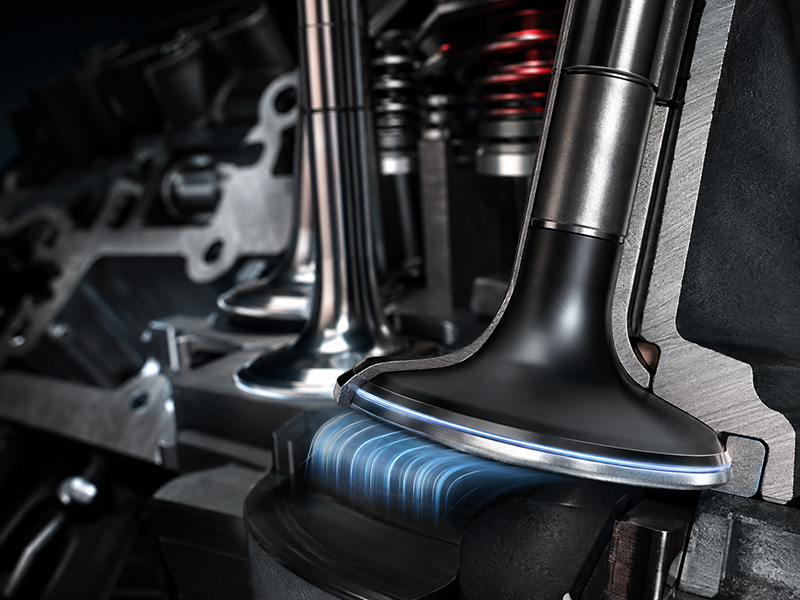
Ford Racing recently released an update on the track-testing progress of its next-generation WEC Hypercar. Powered by a naturally aspirated 5.4-liter V8 based on the Coyote architecture, the race car is scheduled to enter the FIA World Endurance Championship in 2027.
Notably, Ford uses diamond-like carbon (DLC) coatings on the engine valves. Although these films are typically only a few micrometers thick, they can influence component friction, wear, operating temperatures, and long-term reliability.
According to Ford Racing, the engine was designed and manufactured in-house in Michigan. Subsequent track testing will focus on performance, reliability, hybrid-system integration, and aerodynamic validation. Read the Ford Racing testing update
Why Can DLC Coatings Reduce Engine Friction?
During engine operation, components such as valves, valve lifters, camshafts, and piston pins are continuously exposed to high-speed sliding, repeated contact, and heavy loads. Friction at these contact surfaces consumes part of the engine’s output while generating heat and wear.
In an interview with Ford Racing’s powertrain engineering team, Road & Track reported that the V8 is designed to operate at speeds higher than the GT3 engine’s 8,250 rpm. Ford therefore applies DLC coatings to the valves and addresses multiple components to reduce parasitic losses and friction. Read the Road & Track interview
DLC stands for Diamond-Like Carbon. It is not a single coating but a family of functional films based primarily on amorphous carbon. Their properties can be adjusted through hydrogen content, carbon-bonding structure, doping elements, and deposition methods.
DLC combines high hardness with low friction, helping reduce adhesive wear, scratching, galling, seizure, and surface fatigue caused by direct metal-to-metal contact.
How Can a Film Only a Few Micrometers Thick Make a Difference?
Industrial DLC coatings are typically about 1 to 5 micrometers thick. Compared with the engine component itself, this thickness is extremely small, yet it can directly modify the most critical contact interface. See Oerlikon Balzers’ DLC technical information
The main effects include:
1. Reducing Mechanical Losses Caused by Friction
When friction is reduced on sliding surfaces such as the valvetrain, valve lifters, and camshafts, the engine requires less energy to overcome mechanical resistance.
For endurance-racing engines that must operate at high speeds for extended periods, the improvement from a single component may be limited. However, the accumulated effect across multiple friction interfaces can influence overall efficiency.
2. Reducing Wear and Maintaining Component Precision
Repeated contact can gradually alter component clearances, contact positions, and load distribution. DLC uses its high surface hardness to protect the substrate and slow abrasive and adhesive wear, helping components maintain their original dimensions and movement accuracy.
3. Lowering the Risk of Seizure and Surface Damage
Under high contact pressure, insufficient lubrication, or before a complete oil film has formed, local metal-to-metal contact can occur. DLC provides a low-friction protective layer that can reduce the risk of scratching, material transfer, galling, and seizure.
4. Improving Surface Performance Without Significantly Increasing Weight
Because DLC thickness is generally measured in micrometers, it can improve surface performance while adding almost no meaningful weight to the component. This is particularly important for valvetrain systems where reciprocating mass must be carefully controlled.
Nissan engineers previously applied hydrogen-free DLC to engine valve lifters and tested its ability to reduce friction and mechanical losses using actual engine components. The research also examined the relationship between coating-surface topography, film thickness, and abrasive-wear performance. See SAE Technical Paper 2007-01-1752
Thicker DLC Coatings Are Not Necessarily Better
Increasing coating thickness may provide a greater wear allowance, but thicker films may also increase internal stress and raise the risk of reduced adhesion or edge delamination. DLC coating selection should therefore not be based on thickness alone.
An application assessment should also consider:
- Component material and substrate hardness
- Contact pressure and sliding speed
- Operating temperature and lubrication conditions
- Surface roughness and pretreatment quality
- DLC type and deposition method
- Coating thickness, internal stress, and adhesion
- Component geometry, shadowed areas, and thickness uniformity
- Target service life and acceptance-testing methods
Although they are all referred to as DLC, different coatings may be deposited using PVD, PACVD, PECVD, or hybrid processes. Their hardness, coefficient of friction, temperature resistance, and suitable operating environments may differ considerably.
From Racing Technology to General Industrial Components
DLC coatings are not limited to racing applications. Automotive and motorcycle components, fuel-injection systems, camshafts, piston pins, pumps, compressors, mechanical seals, and high-pressure valves may all be suitable candidates when lower friction or longer service life is required.
The key message from the Ford Hypercar example is not that applying DLC will automatically increase engine horsepower by a specific amount. Instead, it demonstrates how surface engineering can improve efficiency and durability at friction interfaces without substantially redesigning the component itself.
CreatingNano DLC Contract Coating Evaluation
Creating Nano Technologies Inc. provides DLC coating and functional thin-film contract services. Suitable pretreatment methods, coating structures, and process parameters can be evaluated according to the substrate, component geometry, operating temperature, friction conditions, and target service life.
Before implementation, coating thickness, hardness, adhesion, friction, wear, and actual component performance should be tested to confirm that the DLC coating meets the requirements of the final operating environment.
Sources
- Ford Racing: Ford Racing Hypercar Testing Underway
- Ford Racing: WEC Hypercar Engine Roars to Life
- Road & Track: Ford’s Coyote Hypercar Engine Is an Exotic V-8
- SAE International: The Development of Hydrogen-free DLC-coated Valve-lifter
- Oerlikon Balzers: DLC Coatings Technical Information
Creating Nano Technologies, Inc.
59 Alley 21 Lane 279, Chung Cheng Road, Yung Kang City, Tainan, TAIWAN
TEL:886-6-2323927 FAX:886-6-2013306 URL: http://www.creating-nanotech.com