

How to Choose a Contact Angle Goniometer: Features, Sample Size, and Requesting a Quote
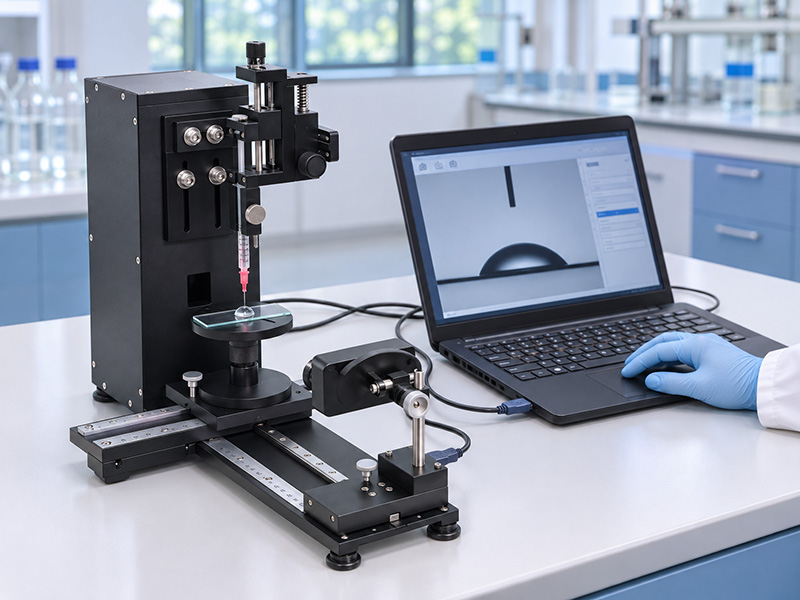
When choosing a contact angle goniometer, comparing prices and measurement ranges is only part of the evaluation. It is also essential to confirm whether the instrument can accommodate your actual samples, provide the data you need, and fit your daily operating and reporting workflows.
Start by evaluating four key areas: measurement objectives, sample requirements, operating methods, and data needs. Defining these requirements in advance makes equipment configuration and quotation discussions more specific and helps with planning subsequent sample tests.
Drawing on Creating Nano’s CAM120/CAM210 brochure and product information on its official website, this article outlines key purchasing considerations for contact angle goniometers, including instruments used to measure water contact angles.
What Is a Contact Angle Goniometer, and Which Surface Properties Can It Evaluate?
A contact angle goniometer, also known as a contact angle meter or water contact angle meter, uses droplet image analysis to measure the angle where a liquid meets a solid surface. This measurement helps evaluate how well the liquid wets the material’s surface.
Under the same test liquid and testing conditions, a smaller contact angle generally indicates that the liquid wets the surface more readily. When water is used as the test liquid, the measurement can serve as an indicator of the surface’s hydrophilic or hydrophobic behavior.
Creating Nano’s published applications include surface inspection of PCBs and electronic components, analysis of material hydrophilicity and hydrophobicity, and biological research. In practice, contact angle measurements can be used to compare surface changes before and after cleaning, plasma treatment, coating, or surface modification, depending on the inspection objective. If acceptance criteria involve residue identification, residue quantity, or bond strength, the corresponding test methods should be agreed upon separately.
1. Confirm the Measurement Capabilities: Static, Dynamic, and Surface Free Energy
Static Contact Angle: Establish a Baseline Under Consistent Conditions
Static contact angle measurement involves capturing an image at a specified time after a droplet is placed on the surface, then analyzing the angle. When comparing different batches or treatment conditions, use the same test liquid, droplet volume, image capture timing, and measurement locations.
In addition to the average angle, retaining the left and right contact angles and original images makes it easier to review the droplet profile and analysis results. The Creating Nano CAM120/CAM210 brochure lists measurement parameters including average angle, left and right angles, droplet volume, and droplet diameter.
Dynamic Measurement: Specify the Type of Change You Need to Observe
If you need to observe how a droplet changes over time, ask about video recording, image capture intervals, and frame-by-frame analysis. The CAM120/CAM210 brochure lists AVI video capture and angle analysis from video frames.
Another type of dynamic contact angle analysis measures advancing and receding angles during wetting and dewetting by increasing or decreasing the droplet volume.
When requesting a quote, specify whether you need to track contact angle changes over time or analyze advancing and receding angles. These methods have different droplet control and analysis requirements. Confirm how each method is supported by the selected model, software, and configuration.
Surface Free Energy: Confirm the Calculation Models and Test Liquids
Surface free energy is calculated from contact angle data and liquid parameters using a mathematical model. Common models such as OWRK and Wu require at least two test liquids with known surface tension components to determine the corresponding surface free energy components.
The CAM120/CAM210 brochure lists a liquid parameter database and calculation methods including Owens, Wu, and Oss & Good. If surface free energy analysis is required, confirm the models supported by the software, the necessary test liquids, and the report contents.
2. Confirm Sample Size: The Sample Must Fit, and the Measurement Location Must Be Visible
Instrument dimensions, sample stage dimensions, and measurable sample dimensions are different specifications.
Before purchasing, provide the sample’s length, width, height, weight, and photographs, and mark the actual droplet application location. For concave surfaces, curved surfaces, films, or large workpieces, also explain how the sample will be secured and the viewing direction. This helps determine whether the dispensing needle and camera’s optical path can access the target area.
CAM120/CAM210 Brochure Specifications
| Item | CAM120 | CAM210 |
|---|---|---|
| Instrument dimensions (L × W × H) | 410 × 250 × 300 mm | 138 × 77 × 196 mm |
| Instrument weight | 3.5 kg | 1.6 kg |
| Optical system | CCD Camera | CCD Camera |
| Image resolution | 800 × 600 pixel | 800 × 600 pixel |
| Power interface | USB 2.0; no additional power cord required | USB 2.0; no additional power cord required |
| Measurement range | 0~180° | 0~180° |
The information above is taken from Creating Nano’s CAM120/CAM210 brochure and is provided only as a specification reference for these two models.
The CAM120 brochure also specifies a sample width of ≤170 mm and a height of ≤60 mm. Allowable sample length should be confirmed based on how the sample is supported and positioned. The CAM210 brochure does not provide length and width limits that can be directly interpreted as maximum measurable sample dimensions. Providing photographs of the actual sample and its measurement location is therefore recommended for evaluation.
Also, measurement range and measurement accuracy must be confirmed separately. The 0–180° specification describes the angular range, while 800 × 600 pixels describes image resolution. When requesting a quote, discuss the target angle range, measurement method, and repeatability requirements as well.
3. Confirm the Operating Method: Which Automation Features Do You Need?
Automatic image analysis, automatic dispensing, automatic positioning, and multipoint measurement involve different capabilities. Start by describing your complete workflow:
Place the sample → Position the measurement point → Dispense the droplet → Capture the image → Analyze the angle → Save the results.
Then identify which steps will be performed manually and which require programmable control. Also specify the number of samples per day, the number of measurement points per sample, and staffing arrangements.
Creating Nano’s official CAM121-Pro(X) product page lists programmable mechanisms, automatic liquid dispensing, and real-time image analysis. An automatic water refill system and a customized sample stage can also be configured according to requirements. Organizations seeking to reduce repetitive manual work can use these features as a starting point for configuration discussions.
If the sample has a concave surface or an obstructed side view, alternative viewing methods may be considered. Creating Nano’s published CAM121-TOP information describes calculating the average contact angle from droplet volume and its diameter on the surface, offering an approach to evaluate for concave samples or samples with obstructed views. Actual suitability must still be confirmed using the sample.
4. Confirm Data Output: Can Results Be Easily Organized and Traced?
For R&D and quality control, the purchasing evaluation should also cover how data will be saved, compared, and delivered.
The Creating Nano CAM120/CAM210 brochure lists Excel data export, graphs, JPG image saving, and AVI video functions. The official CAM121 product page also lists Excel data saving and graphing functions.
Check the following items against your workflow requirements:
- Can the system export the average angle, left and right angles, droplet volume, and droplet diameter?
- Can it retain original images, analysis screenshots, measurement times, and sample IDs?
- Can results from different measurement points, batches, or treatment conditions be compared?
- Can exported files be integrated into your existing reporting and data management workflows?
The brochure also lists synchronized backup to cloud storage. If backup is required, confirm the synchronization method, data paths, and company network permissions before implementation. Compatibility with the computer’s operating system, drivers, and software versions should also be confirmed against the actual configuration to be delivered.
5. What Information Should You Prepare Before Requesting a Quote?
When asking about contact angle goniometer pricing, provide the following information to help clarify requirements for the instrument, software, sample stage, and operation.
- Testing objective: Quality control, R&D, comparison of surface treatments, or surface free energy analysis.
- Sample information: Material, dimensions, weight, shape, photographs, and measurement locations.
- Measurement functions: Static contact angle, changes over time, or advancing/receding angles.
- Test liquids: Liquid types and whether analysis using multiple liquids is required.
- Operating requirements: Daily sample volume, number of measurement points, and automation needs.
- Data requirements: Excel files, images, videos, graphs, and backups.
- Acceptance criteria: Measurement methods, repeatability, and validation using actual samples.
- Implementation requirements: Computer environment, installation space, delivery schedule, and operator training.
How Can You Evaluate Creating Nano’s Contact Angle Goniometers?
Creating Nano’s official website lists several contact angle goniometers that can be discussed further based on your samples and operating requirements:
- CAM121 Contact Angle Goniometer: Published features include average and left/right angles, droplet volume and diameter, static and dynamic measurements, and Excel data export.
- CAM211 Contact Angle Goniometer: Published features include static and dynamic measurements, droplet volume and diameter, and a measurement range of 0–180°.
- CAM121-Pro(X) Automatic Contact Angle Goniometer: Discuss requirements for automatic liquid dispensing, programmable operation, and customized sample stages.
- CAM121-TOP Top-View Contact Angle Goniometer: Evaluate alternative measurement methods for concave samples or samples with an obstructed side view.
The brochure referenced in this article covers the CAM120/CAM210, while the official website also lists products such as the CAM121/CAM211. Confirm the actual model available and the specifications to be delivered when requesting a quote.
Frequently Asked Questions About Purchasing a Contact Angle Goniometer
Are Contact Angle Goniometers and Water Contact Angle Meters the Same?
A water contact angle meter generally refers to an instrument that analyzes contact angles using water droplets. Contact angle measurements can also use other test liquids. Compatible liquids, dispensing modules, and analysis functions must be confirmed for the specific equipment configuration.
Does Dynamic Measurement Include Advancing and Receding Angles?
Confirm the specific method. Observing contact angle changes over time and analyzing advancing/receding angles by increasing or decreasing droplet volume require different control and analysis capabilities.
Can a Single Water Droplet Measurement Determine Complete Surface Free Energy?
To analyze surface free energy and its components using models such as OWRK or Wu, multiple test liquids that meet the model requirements are needed. A single water contact angle measurement cannot replace this analysis.
Do Large Samples Always Need to Be Cut?
This depends on the instrument’s structure, how the workpiece is secured, the measurement location, and the viewing optical path. Provide overall dimensions and photographs first, then confirm whether the sample can be measured directly or whether a smaller specimen is required.
How Should Contact Angle Goniometer Prices Be Compared?
First, align the required measurement functions, sample configuration, level of automation, software, and data output, then compare what is included in each quotation. Actual pricing and the scope of supply should be based on the solution confirmed by the supplier.
If you are evaluating a contact angle goniometer, please provide sample photographs, dimensions, testing objectives, and data output requirements to discuss equipment selection and testing feasibility with Creating Nano.
Creating Nano Technologies, Inc.
59 Alley 21 Lane 279, Chung Cheng Road, Yung Kang City, Tainan, TAIWAN
TEL:886-6-2323927 FAX:886-6-2013306 URL: http://www.creating-nanotech.com