

Semiconductor Decarbonization Through Process Exhaust Management: How Can We Evaluate the Environmental Benefits of Plasma Abatement?
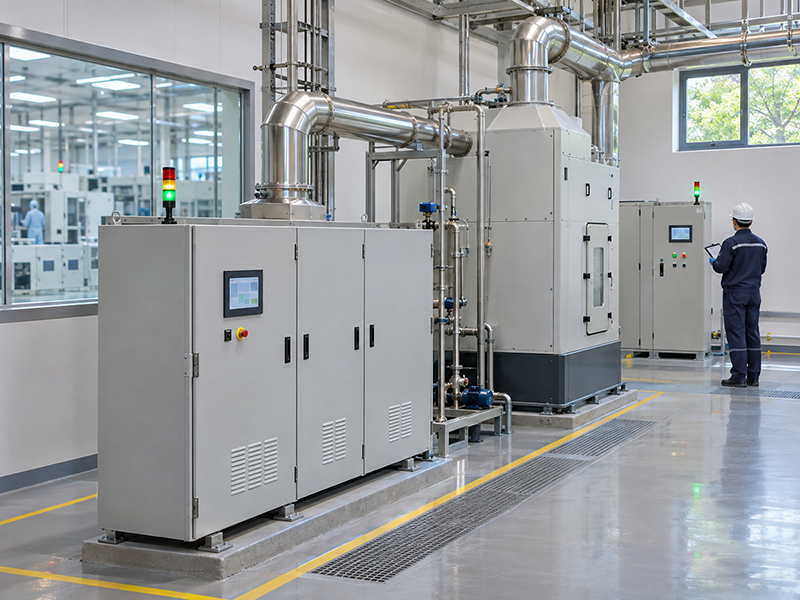
When discussing semiconductor decarbonization, many people first think of energy savings and renewable energy. However, some gases used in chip manufacturing can also have a significant global warming impact.
After these gases have served their purpose in etching or chamber cleaning, unreacted portions may still enter the exhaust system. Collecting, decomposing, and further treating process exhaust is therefore part of low-carbon manufacturing.
Evaluating the environmental benefits of plasma exhaust treatment requires answering three questions together: How much of the target gas was treated? How much energy was used? Where did the decomposition products go?
1. Why Are Fluorinated Process Gases Relevant to Semiconductor Decarbonization?
Semiconductor manufacturing requires precise material removal, pattern formation, and regular removal of residues from deposition chambers. Some processes use fluorinated gases such as carbon tetrafluoride (CF₄), hexafluoroethane (C₂F₆), nitrogen trifluoride (NF₃), and sulfur hexafluoride (SF₆).
Under suitable conditions, these gases provide the reactive fluorine-containing species needed for processing. In practice, however, the gases may not be fully consumed, and other fluorinated by-products may also form.
Many fluorinated gases have high global warming potentials. Global Warming Potential (GWP) compares the warming impact of a given mass of a gas over a specified period with that of the same mass of carbon dioxide. Expressing emissions in carbon dioxide equivalent (CO₂e) provides a common unit for comparing different greenhouse gases.
Therefore, even gases that contain no carbon, such as NF₃ and SF₆, fall within what companies commonly describe as “decarbonization” efforts when their greenhouse gas impact is reduced. Fluorinated gases also belong to different chemical categories and should not all be collectively classified as perfluorocarbons (PFCs).
2. How Does Plasma Treat Exhaust Gases That Are Difficult to Decompose?
Plasma is a state in which a gas has been energized and contains particles such as free electrons and ions. In a high-temperature plasma exhaust treatment system, electrical energy establishes a reaction environment in which incoming gases decompose and transform under suitable conditions.
One way to understand this is that stable molecules that are difficult to treat are converted into substances that can be managed by subsequent treatment steps.
However, the outcome depends on gas type, mixture composition, total flow rate, power, and reaction conditions. Different gases also present different treatment challenges, so equipment configurations should be evaluated against the actual exhaust composition.
In a system combining plasma treatment with wet scrubbing, each treatment stage serves a specific purpose:
| Treatment Stage | Main Purpose | Key Evaluation Points |
|---|---|---|
| Plasma reaction | Decompose and transform target gases | Gas type, flow rate, power, and treatment performance |
| Downstream scrubbing | Absorb acidic and other components suitable for treatment with a scrubbing liquid | Scrubbing conditions, water quality, chemical dosing, and outlet conditions |
| Wastewater treatment | Manage pollutants in the scrubbing liquid | Fluoride, pH, and subsequent treatment methods |
Depending on the characteristics of the exhaust, the actual system may also include cooling, particulate removal, or other treatment units.
3. Why Must Removal Efficiency Be Considered Alongside Test Conditions?
Equipment documentation often refers to Destruction or Removal Efficiency (DRE), which describes the proportion of a target gas destroyed or removed as it passes through treatment equipment.
To interpret this figure, first confirm which gas was tested and the concentration, flow rate, and power used during testing. A result obtained for one gas under specific conditions cannot directly represent the performance of all process gases.
Gas flow rates at both the inlet and outlet must also be included in the calculation. Adding nitrogen or other gases can lower concentrations through dilution. Comparing data corrected for flow and dilution provides a more reliable assessment of treatment performance.
If other greenhouse gases are formed during the reaction, they should also be included in the emissions assessment. The DRE of an individual gas and the greenhouse gas reduction benefits of the overall system describe different levels of performance.
4. Why Must Electricity Use and Downstream Scrubbing Be Included?
Actual Energy Consumption: Looking Beyond Power Ratings
Power is expressed in kW, while electricity consumption is measured in kWh. Evaluating long-term energy use requires knowing how long the equipment operates in treatment, standby, start-up, and shutdown modes.
Beyond the plasma power supply, the assessment should establish whether it includes energy used for cooling, circulation pumps, exhaust extraction, and working-gas supply. Equipment comparisons should use equivalent exhaust loads, treatment objectives, and system boundaries.
Standby energy consumption can be evaluated in relation to the process cycle. Start-up and shutdown sequences should account for residual exhaust clearance and safety interlocks so that energy-saving operation supports emissions management.
Downstream Scrubbing: Tracking the Fate of Decomposition Products
Depending on gas composition and reaction conditions, reactions involving fluorinated gases may produce substances such as hydrogen fluoride (HF). Downstream wet scrubbing can absorb suitable gaseous components and may be combined with neutralization or other procedures as required.
Once these components enter the scrubbing liquid, water quality, fluoride, chemical dosing, and wastewater handling still require management. Including water use and subsequent treatment provides a fuller understanding of the system’s environmental burden.
Operational Reliability: Connecting Individual Tests to Annual Emissions
Annual emissions reductions also depend on the proportion of exhaust actually routed through the treatment system and whether the equipment operates properly while the process is generating exhaust.
The handling of exhaust during maintenance, abnormal operation, or system changeovers, along with backup arrangements and process interlocks, should therefore be assessed. Maintaining operating and maintenance records helps connect test results with actual emissions management.
5. How Can the Decarbonization Benefits of Plasma Treatment Be Initially Assessed?
For an initial comparison, compile emissions before and after an improvement under the same production conditions, over the same period, and within consistent assessment boundaries:
- Exhaust emissions: Actual emissions of each greenhouse gas, including relevant by-products.
- Energy use: Electricity consumed by the treatment system and emissions associated with other energy sources.
- Related inputs: Working gases, water, chemicals, and wastewater treatment, as included within the assessment boundaries.
Once both scenarios are expressed on a consistent CO₂e basis, the difference can be compared. The GWP version, emission factors, and calculation boundaries should also be clearly documented.
If the assessment includes only exhaust emissions and operating electricity, its results apply to that scope. Describing life-cycle environmental benefits requires broader consideration of equipment manufacturing, consumables, end-of-life management, and other stages.
6. How Does Creating Nano Address Process Exhaust Treatment Needs?
The publicly listed features of Creating Nano Technologies Inc.’s APX02 plasma exhaust treatment equipment include high-temperature plasma decomposition, nitrogen as the working gas, wet scrubbing, and ON/OFF interlocking with upstream process equipment. Its stated applications include exhaust treatment for semiconductor process equipment.
These features provide a basis for discussing gas treatment, downstream scrubbing, and production-line integration. The actual configuration and environmental benefits need to be confirmed against gas composition, flow rate, operating mode, and validation results.
For manufacturing facilities, consistently tracking treatment performance, energy inputs, and the fate of pollutants provides a clearer basis for decarbonization efforts and helps demonstrate the environmental value of plasma technology.
If you are evaluating process exhaust treatment, please provide the gas types, flow rates, process timing, and existing treatment methods to discuss equipment configuration and assessment options with Creating Nano.
References
- Creating Nano Technologies Inc.: APX02 Plasma Exhaust Treatment Equipment: Product features and application scope.
- U.S. Environmental Protection Agency: Semiconductor Industry: Fluorinated process gases, emission sources, and reduction approaches.
- U.S. Environmental Protection Agency: Understanding Global Warming Potentials: GWP and the comparison of different greenhouse gases.
- U.S. Environmental Protection Agency: Protocol for Measuring Destruction or Removal Efficiency (DRE): Inlet and outlet measurements, flow rates, and dilution correction.
- IPCC: 2019 Refinement, Electronics Industry Emissions: Emissions assessment covering by-products, abatement coverage, and operating time.
- Lee et al. (2023): A Study on Greenhouse Gas (PFCs) Reduction in Plasma Scrubbers to Realize Carbon Neutrality of Semiconductors and Displays: Plasma-wet systems and the effects of power and flow rate on treatment performance and by-products.
- ISMI (2005): Reduction of Perfluorocompound (PFC) Emissions—State-of-the-Technology Report: Referenced only for the basic principles of plasma treatment and downstream acid-gas scrubbing. Historical equipment performance is not used for comparisons with current systems.
Creating Nano Technologies, Inc.
59 Alley 21 Lane 279, Chung Cheng Road, Yung Kang City, Tainan, TAIWAN
TEL:886-6-2323927 FAX:886-6-2013306 URL: http://www.creating-nanotech.com