

Can DLC Coatings Really Save Energy? A Closer Look at Sliding Components and Maintenance
What Improvement Opportunities Lie in Components That Slide Every Day?
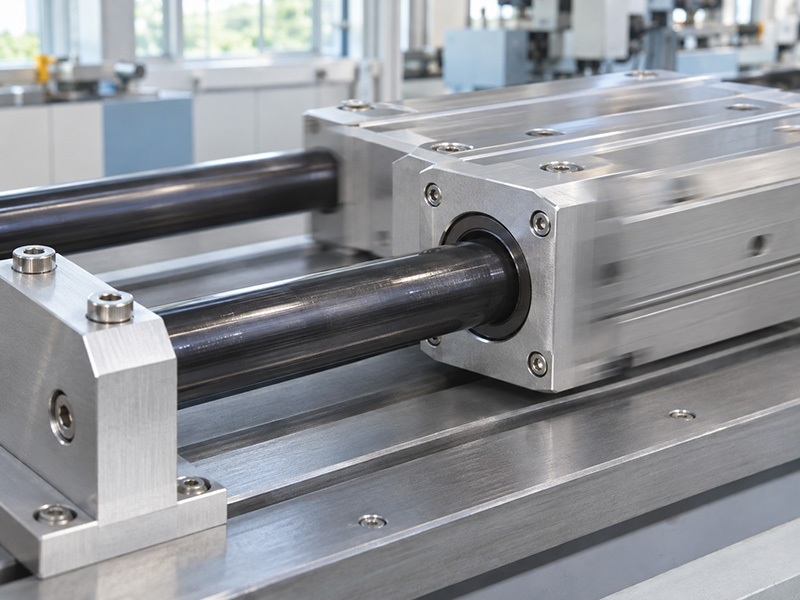
Bearings, guide rails, and transmission components undergo repeated contact and motion. When interfacial friction and wear become problems, operators may encounter increased resistance, surface damage, changes in accuracy, and frequent maintenance or component replacement.
The low-friction and wear-resistant properties of DLC make it a surface treatment worth evaluating for these components. However, friction reduction, lower machine electricity consumption, and longer component life each require separate verification.
To assess whether DLC is worth adopting, start by asking: Where are the losses occurring? What data would demonstrate an improvement?
1. Why Are Low-Friction DLC Coatings Relevant to Energy Efficiency?
DLC, or diamond-like carbon, is a family of carbon-based thin films. An appropriate coating design can improve friction and wear performance under specific contact conditions.
For a continuously sliding interface, lower frictional resistance may reduce the mechanical power needed to overcome friction, with other conditions held constant. This is the link between low-friction coatings and equipment energy efficiency.
DLC performance is not a fixed value. Coating type, substrate support, surface roughness, mating materials, load, temperature, and lubrication conditions all influence the result. Coating selection should therefore consider the complete contact system.
2. Why Is a Lower Coefficient of Friction Not the Same as a Matching Percentage of Electricity Savings?
A machine may use electricity for its drive, heating, cooling, vacuum pumping, and control systems. Even when the contact resistance of one component improves, the change in total electricity consumption depends on how much that frictional loss contributes to the overall load.
Therefore, friction testing can help screen coatings; measurements on the actual machine are needed to establish whether it saves electricity and by how much.
When comparing coated and uncoated components, keep the load, speed, stroke, and production conditions consistent. Record electricity consumption over complete operating cycles and confirm comparable output and quality. A single instantaneous power reading can overlook differences in start-stop operation, standby periods, and extended running.
For production equipment, a useful metric is:
Electricity consumption per conforming unit = Electricity consumed during the measurement period ÷ Number of conforming units produced during the same period
For equipment whose work is defined by motion cycles, electricity consumption can instead be compared per identical operating cycle, linking the assessment to the work actually completed.
3. Include Wear Resistance and Maintenance in Resource-Efficiency Assessments
If contact wear is causing premature replacement, a suitable coating may slow damage. This creates an opportunity to evaluate whether service intervals can be extended and the use of replacement parts and maintenance consumables reduced.
Useful records include:
-
Wear condition: Contact-surface wear tracks, coating damage, dimensional changes, and wear of mating components.
-
Maintenance frequency: Intervals between cleaning, lubrication, adjustment, and component replacement.
-
Resource inputs: Replacement-part quantities, lubricant consumption, and maintenance consumables.
These are potential applications requiring evaluation. If the underlying cause of failure is eccentricity, overloading, substrate deformation, or another structural issue, that problem also needs to be addressed.
Any change in lubricant use requires verification. Results obtained with specific DLC coatings and lubricant-supply conditions in a study cannot directly justify reducing or eliminating lubrication in service.
4. How Can Testing Connect Low Friction With Practical Benefits?
First compare coatings through friction and wear tests, then use actual components to verify electricity consumption, quality, and maintenance performance. These stages answer different questions, and the test conditions should reflect the intended application as closely as practical.
For sample evaluation, compare coated and uncoated parts with consistent materials, dimensions, surface preparation, and assembly conditions.
Record the mating material, load, speed, stroke, temperature, and lubrication. Track friction or torque during startup and steady operation, and compare electricity consumption, operating time, output, and quality over identical cycles.
Also monitor coating adhesion and wear, mating-part damage, maintenance intervals, and replacement-part quantities.
Avoid directly comparing a new coated component with a severely worn old component. Repeat measurements and check that observed differences exceed measurement uncertainty and normal operating variation.
For example, Ihara and colleagues used a reciprocating tribometer to compare friction and wear under different lubricant-supply conditions. The study explicitly states that it examined short-term tribological responses and failure onset, rather than service-life durability. Such research can inform test design, while machine electricity savings and maintenance intervals still need separate verification.
5. Define the Assessment Boundary Before Moving From Electricity Savings to Carbon Reduction
After confirming electricity or consumable savings during use, an assessment of net greenhouse gas reductions also needs to consider inputs associated with the additional coating process, pretreatment, transportation, maintenance, and end-of-life management.
Comparisons should use the same amount of work and assessment period, with consistent boundaries and emission factors. Measuring only operating electricity establishes electricity savings within that use-stage boundary.
Traceable electricity, wear, and maintenance records provide a practical foundation for demonstrating environmental benefits and progressively expanding the assessment scope.
6. Creating’s DLC Coating Services: Start With the Component and Its Operating Conditions
Creating Nano Technologies Inc. publicly lists low friction and wear resistance among the functional applications of its DLC coating services, with bearings, guide rails, and transmission components among the applications shown on its website.
Customers developing precision machinery, equipment, or components can first document existing resistance, wear, or replacement problems. The substrate, contact conditions, and assembly requirements can then guide discussions about coating and sample evaluation.
To evaluate energy and maintenance benefits, prepare the component material and drawings, mating materials, load and speed, temperature and lubrication conditions, and existing electricity or maintenance records. These details help make the testing objectives specific.
Share your component photos and operating conditions with Creating to discuss DLC coating services and sample-evaluation options.
Explore Creating’s DLC coating services | Contact Creating
Creating Nano Technologies, Inc.
59 Alley 21 Lane 279, Chung Cheng Road, Yung Kang City, Tainan, TAIWAN
TEL:886-6-2323927 FAX:886-6-2013306 URL: http://www.creating-nanotech.com