

MIT develops sodium battery, which has three times the energy density of lithium battery and injects new impetus into electric aviation
TechNews Technology News
June 17, 2025
Author YAP KUO
June 17, 2025
Author YAP KUO
The Massachusetts Institute of Technology (MIT) has recently successfully developed a breakthrough fuel cell with an energy density more than three times that of current lithium batteries, which greatly improves the storage capacity. It not only eliminates the range anxiety of electric car owners, but also brings revolutionary opportunities to the stagnant electric flight. The paper was published in the journal Joule in May.
Yet-Ming Chiang, a Taiwanese doctor from the Department of Materials Science and Engineering at MIT who led the research, said: "The popularization of electric flight requires lighter and more efficient batteries. The new technology not only helps aircraft, but also has the potential to drive the full electrification of trucks and ships."
The core is a metal-air fuel cell, which uses liquid sodium as fuel and is equipped with a layer of solid ceramic electrolyte to allow sodium ions to pass smoothly, while avoiding direct contact between fuel and air, improving system safety. Compared with expensive and supply-constrained lithium, sodium is abundant and cheap, and has great sustainable potential. In addition, the fuel can be replaced quickly without charging to replenish energy.
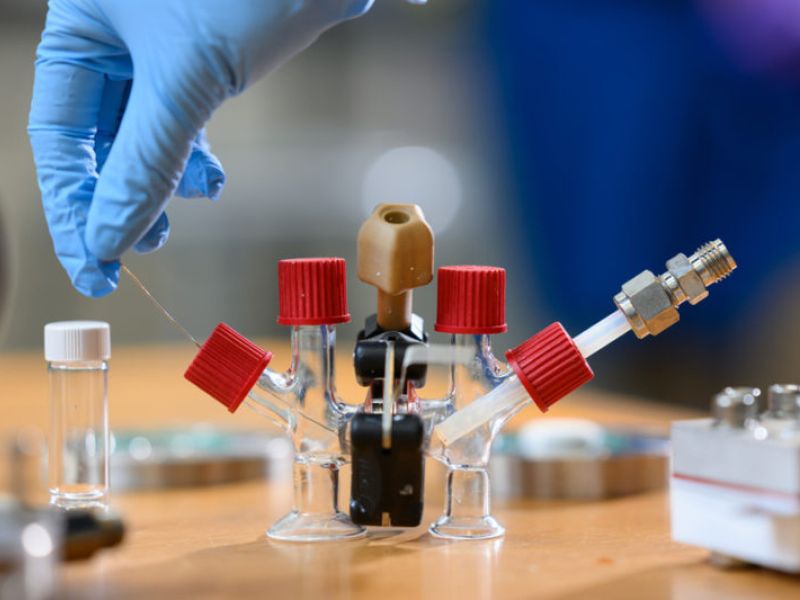
The team tested two experimental prototype batteries: one is an "H-type design" and the other is a "horizontal design". The battery precisely controls the humidity of the air, and the battery reaches an energy density of about 1,700Wh per kilogram. Even considering system losses, it still reaches 1,000Wh/kg, which is three times the energy density of mainstream commercial lithium batteries (about 300Wh/kg). A group of fuel cells the size of a lunch box can allow an agricultural drone to fly continuously for several hours.
Unlike jet engines, the new fuel cell does not emit carbon dioxide, but sodium oxide (sodium oxide), which reacts with air moisture to form sodium hydroxide. Even better, sodium hydroxide will continue to absorb carbon dioxide and convert into sodium carbonate and baking soda (sodium bicarbonate). Therefore, the new battery not only does not emit carbon, but also "absorbs carbon"!
Starting with a breakthrough battery, heading towards aviation applications
One of the members, doctoral student Karen Sugano, said that the key discovery is that "humidity determines the efficiency of the reaction." If the airflow is too dry, the reaction products will accumulate into an insulating layer, hindering the reaction from continuing. Another member, Saahir Ganti-Agrawal, also said: "This research seems to have recombined multiple technologies that were ignored in the past, from high-temperature batteries to fuel cells, to air electrode design, and finally gave birth to a new battery system with amazing performance." To promote commercialization, the team has established a new startup, Propel Aero, to conduct large-scale drone flight tests within a year, and then gradually expand to the field of electric aviation.
The new battery subverts people's impression of batteries. Replacing lithium with sodium is not only cheaper and safer, but also has the potential to "absorb carbon." Dr. Jiang Yeming said: "The environment will naturally improve without doing anything deliberately." And replenishing energy is like refueling, without the need to spend time charging, which greatly improves convenience. If it can be developed smoothly, the new battery will become the core power of new aircraft. From urban drone express delivery to long-distance flight range, batteries are no longer a supporting role in aviation vehicles, but a new hope to replace fuel.
Related link: https://technews.tw/2025/06/17/new-fuel-cell-could-enable-electric-aviation/
Image source: Gretchen Ertl / MIT
Image source: Gretchen Ertl / MIT
【Disclaimer】
The content of this article only represents the author's personal views and has nothing to do with Creating.
The content, text description and originality have not been verified by this site. This site does not make any guarantee or commitment to this article and all or part of the content, authenticity, completeness, and timeliness. It is for readers' reference only. Please verify the relevant content yourself.
The content of this article only represents the author's personal views and has nothing to do with Creating.
The content, text description and originality have not been verified by this site. This site does not make any guarantee or commitment to this article and all or part of the content, authenticity, completeness, and timeliness. It is for readers' reference only. Please verify the relevant content yourself.
Creating Nano Technologies, Inc.
59 Alley 21 Lane 279, Chung Cheng Road, Yung Kang City, Tainan, TAIWAN
TEL:886-6-2323927 FAX:886-6-2013306 URL: http://www.creating-nanotech.com
59 Alley 21 Lane 279, Chung Cheng Road, Yung Kang City, Tainan, TAIWAN
TEL:886-6-2323927 FAX:886-6-2013306 URL: http://www.creating-nanotech.com