

AI giants vie for CoWoS advanced packaging; TSMC and Taiwanese packaging and testing companies accelerate capacity expansion.
TechNews Report
January 12, 2026
Author: Central News Agency, Chung Jung-feng
Author: Central News Agency, Chung Jung-feng
Demand for Artificial Intelligence (AI) and High-Performance Computing (HPC) chips remains strong this year, leading to a supply shortage of CoWoS advanced packaging. Market assessments indicate that TSMC is continuing to expand its CoWoS capacity in Taiwan. Taiwanese packaging and testing companies, including ASE Technology Holding and King Yuan Electronics, are actively vying for advanced testing capabilities, while companies like Ingenic Semiconductor, Precision Test Systems, and Win Semiconductor are accelerating the expansion of testing interfaces required for AI chips.
Starting in the second half of 2025, several large-scale AI data center collaborations are expected to materialize, driving a significant increase in the demand for AI chips. The increasing complexity of AI platform heterogeneous integration and chiplet architecture design, coupled with growth in demand from non-AI applications such as smartphones and high-speed networking chips, will contribute to the continued strong demand for advanced packaging such as CoWoS this year.
Market assessments indicate that demand for CoWoS advanced packaging from major chip manufacturers such as NVIDIA, AMD, Broadcom, Qualcomm, and MediaTek will continue to increase from this year to 2027.
Furthermore, demand for CoWoS advanced packaging is also significantly increasing from AI-customized application-specific integrated circuits (ASICs), including Google's TPU series (codenamed Axe and Hammer, etc.), Broadcom's Hellcat platform, Tesla's Dojo supercomputer and Full Self-Driving (FSD), Amazon's AWS Trainium series, Microsoft's Athena, and Meta's MTIA architecture.
Analysts predict that TSMC's monthly CoWoS advanced packaging capacity will expand from 70,000 wafers per month at the end of 2025 to 115,000 wafers per month by the end of this year. Due to the continued shortage of CoWoS capacity, TSMC is expected to gradually transform its existing 8-inch wafer fabs in Taiwan into advanced packaging plants.
ASE Technology Holding Co., Ltd. continues to benefit from the spillover effect of CoWoS demand this year. In addition to expanding its CoWoS back-end OS packaging capacity, analysts assess that ASE has the potential to secure orders from Broadcom, Nvidia, AMD, and Amazon for its front-end CoW process this year, with estimates suggesting that ASE's CoWoS capacity target will double this year.
Furthermore, the extended testing time for AI chips and the significant increase in the number of pins required for testing continue to benefit Taiwanese packaging and testing companies. Analysts point out that an increasing number of wafer testing outsourcing orders are shifting from TSMC to ASE and King Yuan Electronics Co., Ltd.
King Yuan Electronics has planned capital expenditures of NT$39.372 billion this year, exceeding the NT$37 billion target for 2025, setting a new record. Analysts assess that King Yuan Electronics will expand its capacity by 30% to 50% this year to meet the testing needs of companies including Nvidia and ASIC chip manufacturers, especially in the high-power burn-in testing segment, where King Yuan Electronics plays a crucial role.
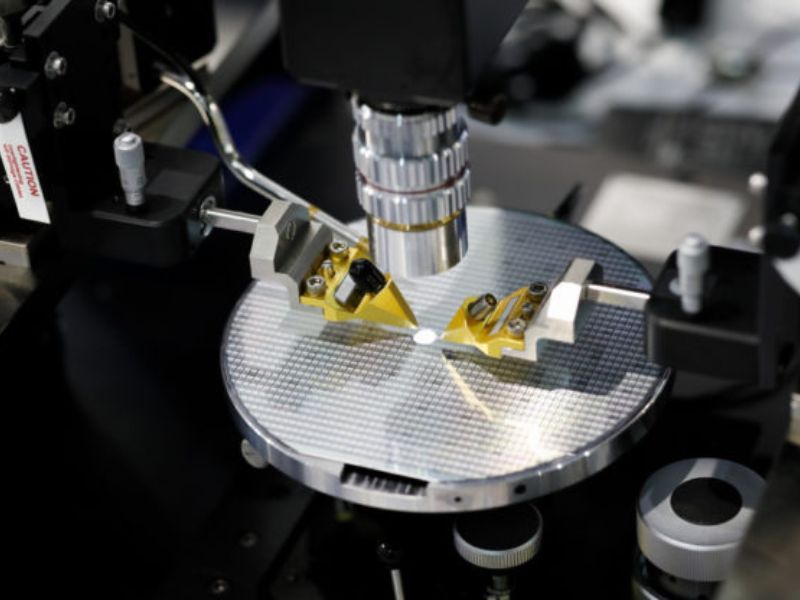
Taiwanese test interface manufacturers continue to benefit from the increased demand for AI and HPC chip testing this year. Yingwei stated that the extended testing times for wafer sorting, final product testing/ATE (FT/ATE), and system testing (SLT) have driven demand for high-end test sockets and vertical probe cards.
Yingwei pointed out that driven by demand for CoWoS advanced packaging and chiplet high-end packaging KGD (Known Good Die), Yingwei continues to expand its MEMS probe card production capacity.
Chunghwa Precision Test recently issued NT$2 billion in unsecured convertible bonds (CB), bringing its total fundraising to NT$2.568 billion. Chunghwa Precision Test explained that the funds raised will be used for the construction of a third factory to improve probe card and chip test substrate technology, meeting the testing needs of semiconductor test interfaces, AI applications, and memory modules.
Wonsilicon stated that HPC chips are driving demand for probe cards, which are used in testing artificial intelligence and application-specific integrated circuits (ASICs) for high-frequency, high-speed transmission. In terms of production capacity, Creating Nano Technologies, Inc. continues to plan to increase its production capacity for vertical modular PCs (VPCs) and MEMS probe cards.
Related Link: https://technews.tw/2026/01/12/ai-cowos-war/
【Disclaimer】
The content of this article only represents the author's personal views and has nothing to do with Creating.
The content, text description and originality have not been verified by this site. This site does not make any guarantee or commitment to this article and all or part of the content, authenticity, completeness, and timeliness. It is for readers' reference only. Please verify the relevant content yourself.
The content of this article only represents the author's personal views and has nothing to do with Creating.
The content, text description and originality have not been verified by this site. This site does not make any guarantee or commitment to this article and all or part of the content, authenticity, completeness, and timeliness. It is for readers' reference only. Please verify the relevant content yourself.
Creating Nano Technologies, Inc.
59 Alley 21 Lane 279, Chung Cheng Road, Yung Kang City, Tainan, TAIWAN
TEL:886-6-2323927 FAX:886-6-2013306 URL: http://www.creating-nanotech.com
59 Alley 21 Lane 279, Chung Cheng Road, Yung Kang City, Tainan, TAIWAN
TEL:886-6-2323927 FAX:886-6-2013306 URL: http://www.creating-nanotech.com