

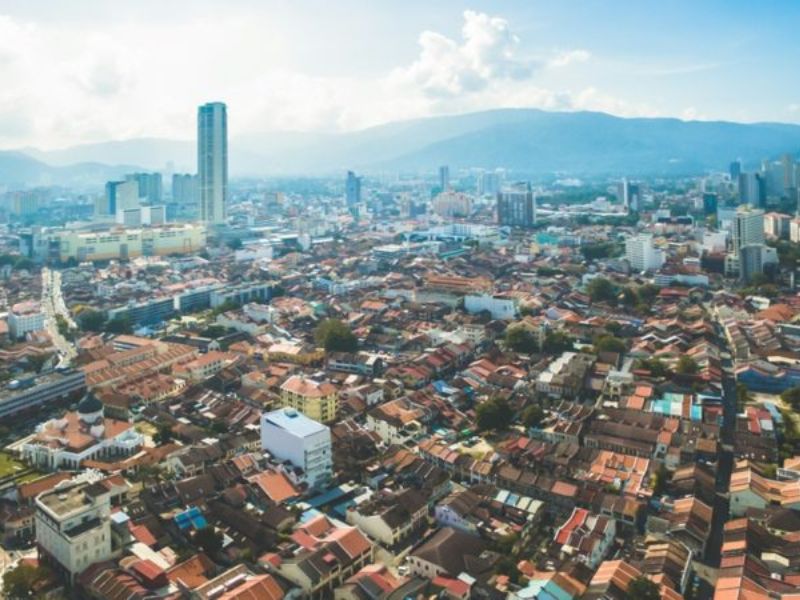
Taiwan plays a key role in connecting the spillover effects of the Penang semiconductor cluster.
TechNews Report
May 19, 2026
Author: Huang Ziqiang, Central News Agency
Author: Huang Ziqiang, Central News Agency
The global semiconductor supply chain is undergoing accelerated restructuring due to geopolitical influences, with Penang, Malaysia, becoming a key foothold for Taiwanese businesses expanding into Southeast Asia. In addition to the rapid clustering of chip and electronics manufacturing, related industries such as metal materials and precision machining are also expanding simultaneously, forming a tightly integrated industrial cluster.
The Penang semiconductor industry cluster has continued to expand in recent years, gradually incorporating Kedah and Perak into the supply chain. Besides the Bayan Lepas Industrial Park and Bukit Minyak Industrial Park in Penang, the Kamunting Industrial Park in Taiping, Perak, connected to Penang via the North-South Expressway, has also developed into a cross-state industrial economic zone.
Taiwanese materials technology companies deeply rooted in the Kamunting and Bukit Minyak Industrial Parks are a significant microcosm of the spillover effect of the semiconductor supply chain in northern Malaysia.
Precision Plastic Injection Molding Enters the Semiconductor Supply Chain
Stepping into the factory, precision plastic injection molding machines operate smoothly, technicians focus on inspecting mold precision, occasionally discussing process parameters and product details in hushed tones. On the other side, automated components are neatly arranged, awaiting subsequent inspection and shipment; the production line exudes the rhythm unique to precision manufacturing.
Huang Huiling, who works in precision plastic injection molding, went to Malaysia more than 30 years ago. She started with speaker enclosures and car audio parts, later transitioning to motorcycle plastic parts. Now, with the formation of the Penang semiconductor cluster, she is shifting her focus to the semiconductor automation equipment and related component market.
In an interview with the Central News Agency, Huang Huiling stated that the continued investment in Penang by technology manufacturers from the United States, Europe, Japan, Taiwan, and other countries in recent years is not a short-term phenomenon, but a significant trend in global supply chain restructuring and industrial upgrading.
She cited applications in semiconductor automated warehousing systems and battery handling robots as examples to illustrate the extremely high requirements for cleanroom environments in semiconductor manufacturing processes. Automated equipment plays a crucial role in maintaining transportation efficiency and cleanliness, and is thus gradually entering the semiconductor supply chain. Huang Huiling believes that Penang, after decades of development, has established a complete and mature electronics and semiconductor industry ecosystem, earning it the reputation of "Silicon Valley of the East." Companies coming to Penang "are not just looking for factories, but also for the ability to quickly connect with supply chains, talent, and international clients."
She says that under the "China Plus One" strategy and the trend of supply chain decentralization, Malaysia, with its geographical location, multilingual talent pool, and relatively neutral economic and trade environment, is gradually becoming an important option for multinational companies expanding into Southeast Asia. Meanwhile, Taiwan's long-accumulated manufacturing experience and supply chain integration capabilities play a crucial connecting role in Penang's semiconductor cluster.
Acrylic Protective Materials Benefit from Cluster Effect
The expansion of the semiconductor cluster has also led to a surge in demand for surrounding materials and processing industries. Inside the factory, machines producing acrylic protective paper operate continuously, with automated inspection equipment monitoring the paper's adhesive thickness and temperature to maintain optimal quality. Rolls of coated protective paper are neatly arranged, awaiting shipment.
Hsu Shang-chih, a Taiwanese businessman with over 30 years of experience, has become one of the world's largest suppliers of acrylic protective paper. While his products may seem unrelated to the semiconductor supply chain, the continued expansion of Penang's semiconductor and high-end manufacturing cluster has driven up demand in related materials, processing, and supporting industries, benefiting the acrylic sheet and protective material market from this spillover effect.
Hsu told the Central News Agency that although protective paper is merely the outer layer of the sheet, it must simultaneously possess four key characteristics: easy to apply, easy to tear, leaves no residue, and durable, to maintain the sheet's value and the quality of subsequent processing.
He pointed out that with the increasing demand for digital printing, customized processing, and laser cutting, the market's requirements for sheet flatness, cleanliness, and surface protection are also rising, further driving the growth in demand for high-quality protective materials.
Hsu Shang-chih believes that as the supply chain in northern Malaysia continues to upgrade, the requirements for processing precision, material stability, and quality control in high-end electronics manufacturing are simultaneously increasing, further driving the surrounding materials industry towards standardization, traceability, and high quality. Penang's comprehensive advantages in talent, logistics, and supply chain are also allowing surrounding states to gradually benefit from the spillover effect of the semiconductor cluster.
Metal Sheet Industry Rises to High-End Manufacturing Demand
Wang Guan-hong, a metal sheet industry operator who has been based in Butterworth, Malaysia for over 10 years, stated that Malaysia possesses advantages in water, electricity, labor, and tax costs. Coupled with a relatively stable political environment, this has attracted many Taiwanese businesses to relocate from China to northern Malaysia in recent years, gradually forming a technology manufacturing cluster.
He cited the metal sheet industry as an example, saying that the semiconductor high-tech industry in Malaysia is booming. In the metal processing industry, demand for metals such as copper, stainless steel, aluminum, iron, and cold-rolled hot-dip galvanized steel sheets (SGCC) is strong, especially for copper and SGCC. In recent years, with the continuous increase in investment in Penang's semiconductor, server, and data center industries, the demand for related metal materials has also risen significantly.
Wang Guan-hong stated that cold-rolled hot-dip galvanized steel sheets possess rust resistance and processing characteristics, making them widely used in electronic equipment, machinery manufacturing, and industrial processing. As more and more Taiwanese businesses relocate from China to Malaysia, the metal materials market is further driven to grow.
He believes that Malaysia has gradually become an important technology manufacturing base in Southeast Asia in recent years. Not only is its semiconductor cluster expanding, but the government is also simultaneously promoting the development of industrial zones, hydropower, and infrastructure, providing favorable conditions for high-tech industries to establish themselves there.
Wang Guan-hong pointed out that Malaysia allows 100% foreign ownership, has relatively low labor and operating costs, and a relatively stable political environment, all of which are important factors attracting Taiwanese businesses. If Taiwan and Malaysia can further strengthen investment protection mechanisms in the future, it will also help boost Taiwanese businesses' confidence in investing in Malaysia.
From precision plastic injection molding and acrylic protective materials to metal processing, more and more Taiwanese companies are following the development of the high-tech industry in northern Malaysia, gradually finding new market positioning and development space around Penang.
Related Link: https://technews.tw/2026/05/19/penang-semiconductor-cluster-spillover-taiwan-key-connecting-role/
【Disclaimer】
The content of this article only represents the author's personal views and has nothing to do with Creating.
The content, text description and originality have not been verified by this site. This site does not make any guarantee or commitment to this article and all or part of the content, authenticity, completeness, and timeliness. It is for readers' reference only. Please verify the relevant content yourself.
The content of this article only represents the author's personal views and has nothing to do with Creating.
The content, text description and originality have not been verified by this site. This site does not make any guarantee or commitment to this article and all or part of the content, authenticity, completeness, and timeliness. It is for readers' reference only. Please verify the relevant content yourself.
Creating Nano Technologies, Inc.
59 Alley 21 Lane 279, Chung Cheng Road, Yung Kang City, Tainan, TAIWAN
TEL:886-6-2323927 FAX:886-6-2013306 URL: http://www.creating-nanotech.com
59 Alley 21 Lane 279, Chung Cheng Road, Yung Kang City, Tainan, TAIWAN
TEL:886-6-2323927 FAX:886-6-2013306 URL: http://www.creating-nanotech.com