

Integrated Liquid Cooling, 800V Power Distribution, and Sensing Analytics: Data Centers Break Through Thermal Limits
Micro Electronics
July 2, 2026
Author : Donal McCarthy
Driven by the explosive growth of data, AI, and complex computing workloads, data centers are undergoing rapid transformation and expansion. As hardware density inside server racks continues to increase, data centers are facing two critical challenges: how to deliver power efficiently and how to dissipate heat effectively.
In modern AI systems, especially those designed for AI and machine learning, massive computing resources are being compressed into increasingly limited spaces. More transistors, denser GPU clusters, and high-performance accelerators not only drive up power consumption, but also make heat accumulation within confined spaces increasingly difficult to manage.
The bottleneck for data centers has shifted from floor space and power supply to cooling capacity. Across the industry, from traditional operators to hyperscale cloud service providers, this turning point in thermal management is forcing the sector to fundamentally rethink how systems are designed, managed, and optimized.
The “Thermal Wall” Challenge
Rapidly Increasing Density
Traditional racks operate at power levels in the tens of kilowatts. AI workloads, such as ChatGPT, require 40kW to 60kW of GPU rack power. Emerging hyperscale AI factories, built specifically for AI training and inference, have already exceeded 100kW per rack, with future targets reaching 500kW and even 1MW.
Air Cooling Cannot Scale Effectively
Air is an inefficient medium for heat transfer. At high compute densities, air cannot remove heat quickly enough. The only available response is to increase airflow speed, fan power, and rack-level complexity, but this approach is not sustainable. Once rack power exceeds approximately 50kW to 100kW, traditional CRAC (Computer Room Air Conditioner) and CRAH (Computer Room Air Handler) systems become both impractical and uneconomical.
Growing Thermal Risk
Insufficient cooling leads to reduced performance, shorter component lifespan, and higher operating costs. It is becoming a major factor limiting performance, system availability, and capacity. Every additional watt spent on cooling is one less watt available for computing power.
Rethinking Power Delivery and Cooling
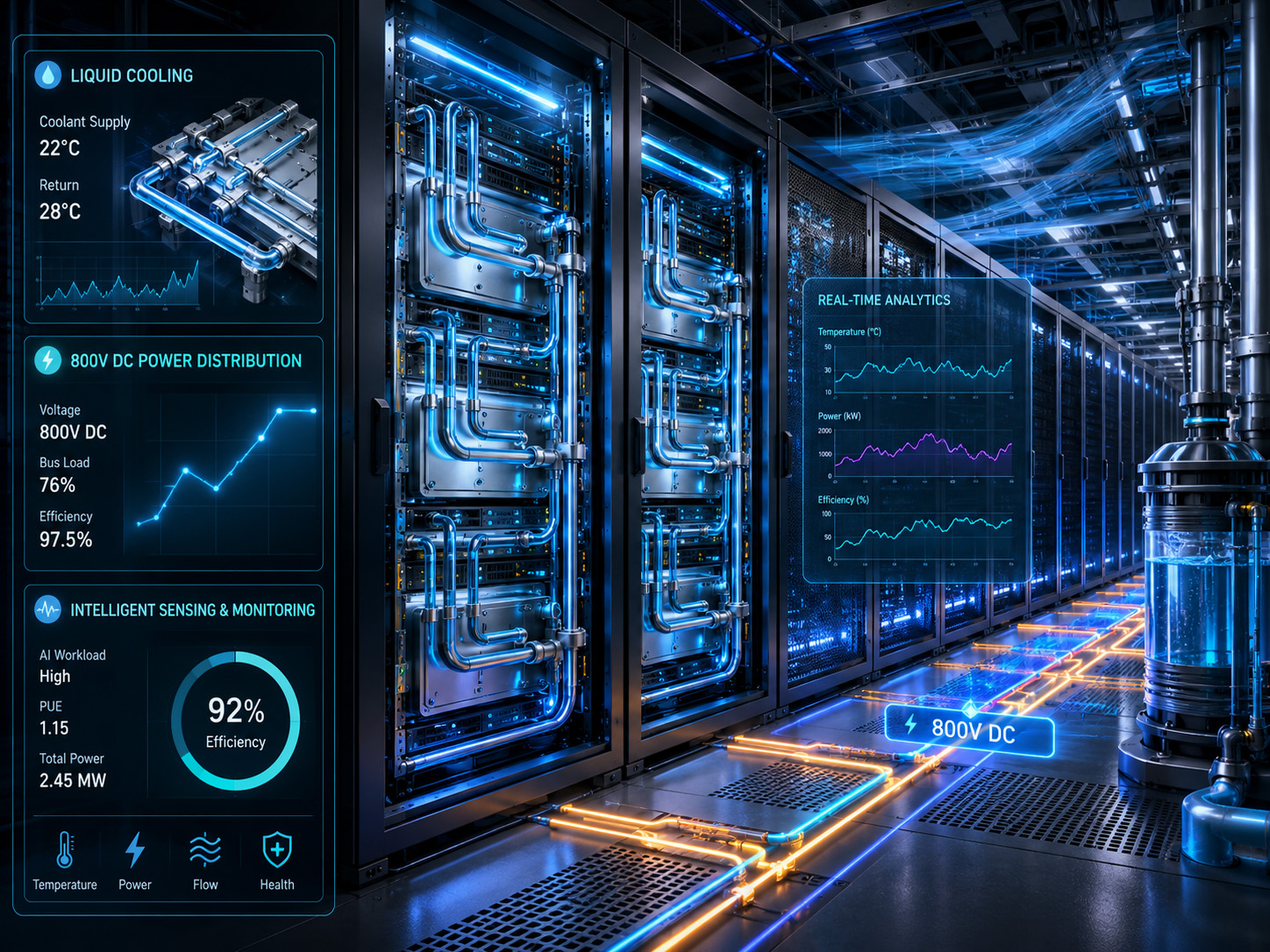
As processor power increases and chip density rises, system heat generation has exceeded the limits that traditional air-cooling systems can address efficiently or economically. This bottleneck is driving data centers to adopt liquid cooling technology and fundamentally redesign thermal management, enabling significantly higher cooling efficiency than traditional air-cooling systems. Today, cooling technology is evolving in coordination with power delivery, rack layout, and airflow design. It is this system-level integration that allows hyperscale AI data centers to break through existing density limits.
Liquid Cooling Solutions
Thanks to its superior thermal conductivity, liquid can remove heat directly at the source. Although liquid cooling introduces additional complexity and cost, this transition has become unavoidable. Hyperscale cloud service providers are building fully liquid-cooled facilities. Existing data centers are adopting hybrid strategies: high-density racks use liquid cooling, while other areas retain air cooling. Liquid cooling is not only essential for solving today’s thermal load challenges, but also critical for data centers of all sizes as they continue to support growing AI workloads.
Improving Power Efficiency to Reduce Thermal Loss
Operators must balance heat removal with heat prevention. This is not only a thermal management issue, but also a challenge across the entire power delivery chain. A more fundamental approach is to reduce heat generation at the source: improving power conversion efficiency, reducing resistive losses, and optimizing voltage regulation to minimize energy lost as heat. In this way, thermal pressure can be reduced before it becomes a problem.
Powering the Future: 800V DC Distribution
Large-scale AI cluster racks pose a serious challenge to traditional power systems. 12V, 48V, and 415VAC architectures rely on large amounts of copper wiring, bulky power supply units, and inefficient conversion chains, all of which increase heat generation. The industry is moving toward 800V DC power distribution architectures to reduce conductor usage, lower resistive losses, and simplify the power delivery chain.
ADI provides hot-swap controllers, efficient DC-DC conversion, power monitoring, and advanced protection functions for 800V DC architectures, helping ensure stable and efficient power delivery.
Intelligent Monitoring and Operations
Advanced monitoring capabilities can track voltage, current, and temperature in real time, enabling more precise resource allocation. If cooling pumps do not need to operate at full speed, keeping them at full load creates unnecessary energy waste. Measuring current shunt signals through key components such as high-precision metering devices and low-noise amplifiers is an important foundation for efficient power delivery and thermal management.
To ensure reliability, operators typically run systems at around 99.95% power rather than 100%. ADI’s monitoring solutions track these power variations in real time, allowing operators to dynamically adjust load structures and balance performance with system lifespan.
Advances in AI are increasing the demand for power and high-performance data centers, while also providing the intelligence needed to manage these demands efficiently. AI acts as an intelligent assistant, processing sensor data to identify patterns, predict failures, and automate adjustments, thereby improving operational efficiency. As a result, operators can detect anomalies before downtime occurs and dynamically adjust cooling strategies based on real-time workloads, transforming maintenance from a reactive process into a proactive one.
At the rack level, a range of dedicated components makes higher performance possible:
- Hot-swap controllers and protection ICs: These manage hot-swap procedures, limit inrush current, prevent spikes, detect faults, and ensure safe operation. These functions are especially important for 800V power delivery and megawatt-scale loads.
- Voltage regulation and DC-DC conversion: High-efficiency regulators and multiphase controllers step down 800V DC to the voltages required by GPUs, CPUs, memory, and other components. ADI solutions help optimize conversion efficiency and minimize losses and thermal load.
- Telemetry monitoring and thermal sensing: These provide real-time visibility and control in high-density environments, enabling operators to identify issues and manage system thermal limits.
- Battery and capacitor backup power systems: These monitor the backplane voltage that powers IT racks. When power fluctuates or is interrupted, these systems provide power or absorb charge as needed. ADI’s battery management solutions, originally developed for automotive applications, help ensure uninterrupted operation during power transitions.
Together, these components support stable high-voltage distribution and precise power and thermal control, making high-density liquid-cooled racks practical, safe, and manageable.
Business Benefits of Intelligent Data Centers
- Efficiency improvements from liquid cooling can reduce overall energy demand by 15% to 20%.
- Higher efficiency means lower electricity costs.
- Carbon emissions can be reduced by 15% to 21%, while also lowering water usage and auxiliary power consumption.
- New architectures and advanced technologies help data centers achieve significant performance improvements.
- High-precision sensing and AI-driven maintenance help reduce downtime and extend equipment lifespan.
- Intelligent control systems allocate resources according to demand, improving energy utilization efficiency.
- Liquid cooling enables higher compute density.
After adopting these approaches, enterprises and organizations can typically reduce operating costs, lower the number of failures, and steadily advance their sustainability goals. As overall operating scale increases, these benefits are amplified.
Future data centers will become precisely coordinated ecosystems, where advanced components such as power management, sensing technologies, optical connectivity, and battery management work seamlessly together. This system-level integration not only addresses today’s challenges, but also supports the computing demands of the future. Whether upgrading legacy facilities or planning new projects, liquid cooling can play a key role in data centers of all sizes, allowing data centers to remain critical hubs of digital innovation.
The transformation of data centers is focused not only on improving thermal management and energy efficiency, but also on supporting the continued growth of AI computing demand in the future.
【Disclaimer】
The content of this article represents only the personal views of the author and is not related to Creating Nano Technologies, Inc.
The accuracy, wording, and originality of the content have not been verified by this website. This website makes no guarantees or commitments regarding the truthfulness, completeness, or timeliness of this article, in whole or in part. The content is provided for reference only. Readers are advised to independently verify the relevant information.
Creating Nano Technologies, Inc.
59 Alley 21 Lane 279, Chung Cheng Road, Yung Kang City, Tainan, TAIWAN
TEL:886-6-2323927 FAX:886-6-2013306 URL: http://www.creating-nanotech.com