

How Will Energy Autonomy Transform Industry and Everyday Life?
CTIMES
July 10, 2026
By Hsiu-chen Wang
In 2026, the global energy landscape is undergoing its most profound paradigm shift since Edison invented the electric grid: Energy Autonomy.
Over the past century, human society has relied on what could be described as the “large-reservoir theory”: electricity is generated by distant nuclear, coal-fired, or large-scale renewable power plants, then transmitted one-way through hundreds of kilometers of high-voltage grids to factories, cities, and homes. However, this long-established one-way system has now officially hit a wall of physical and capacity limits, driven by the computing explosion of generative AI and agentic AI, the widespread adoption of electric vehicles, and increasingly strict carbon-neutrality targets around the world.
Introduction: A Decentralized Power Tsunami
The demand for electricity from AI chips and heavy industry is rising exponentially, while the intermittent nature of renewable energy continues to challenge the stability of traditional power grids. Historical pressure has turned smart microgrids and distributed energy from environmental ideals into essential survival solutions.
Whether it is a supercomputing factory consuming hundreds of megawatts, electric vehicles running through city streets, or each household in a residential community, energy users are shifting from being simple electricity consumers to becoming prosumers—autonomous energy entities capable of generating, storing, and dispatching power.
This revolution, ignited by microscopic semiconductor materials, intelligent software, and green energy storage, is redefining how human society operates across factories, mobility, homes, and platform-based business models.
A New Energy Strategy for AI Factories: From Power-Hungry Giants to Self-Sufficient Systems
In this wave of energy autonomy, the first to feel the pressure are the AI factories standing at the forefront of technology.
“The power density of a single cabinet in a traditional data center is around 20kW, while AI workloads can push cabinet density to 150kW or even higher. Power delivery, cooling, and space planning all need to be redesigned,” said Yin Zheng, Executive Vice President of China and East Asia Operations at Schneider Electric, during COMPUTEX 2026. He noted that the speed of AI infrastructure upgrades and deployment timelines has shortened dramatically, pushing the entire industry into a faster upgrade cycle.
Paul Tyrer, Global Vice President of Global IT Channels at Schneider Electric, also emphasized: “In next-generation infrastructure, how to balance AI growth, energy demand, and sustainability has become an innovation challenge that the entire ecosystem must face directly.”
To survive, AI factories and Taiwan’s supply chains are launching a strategic counteroffensive around energy autonomy.
1. Power Restructuring from the Grid to the Chip
Compared with traditional IT architectures, AI workloads are growing exponentially. Chen Ying-yuan, Vice President and General Manager of Delta’s Power and System Business Group, stressed: “In the next one to two years, current AC-DC power architectures will face major challenges. High-voltage DC designs centered on HVDC can reduce distribution losses and improve energy efficiency, making them a key solution.”
Himanshu Prasad, Senior Vice President at Schneider Electric, also explained that after power conversion is completed by a sidecar cabinet, supplying 800VDC directly to AI computing cabinets can reduce current requirements, lower transmission losses, and free up rack space for more GPUs.
2. The Rise of Autonomous Microgrids and Containerized Data Centers
Future AI factories will no longer rely entirely on traditional power grids. Delta Chairman and CEO Ping Cheng stated: “As AI data centers continue to expand, their enormous power demand poses a major challenge to traditional grids. Improving energy efficiency and power stability has become urgent, and this is also driving microgrids to become a key trend.”
Delta’s data center microgrid solution integrates renewable energy, energy storage systems, and solid oxide fuel cells (SOFC), ensuring that data centers can maintain uninterrupted operations even when grid connection is delayed or when they must operate off-grid.
Similarly, addressing the pain point of limited modern grid capacity, MiTAC General Manager Rick Hwang noted that MiTAC is actively working through close ecosystem partnerships to fully unlock AI workloads. The “TonoForge modular data center,” jointly developed by MiTAC and Tonomia, integrates liquid-cooled servers with energy management systems. It significantly shortens the construction timeline for data centers once limited by site conditions to just 12 weeks, enabling highly efficient and flexible energy deployment.
3. Digital Twins and Intelligent Management of Cooling, Compute, and Energy Efficiency
Facing such a complex autonomous power chain, Supermicro President and CEO Charles Liang stated: “By combining new high-efficiency architectures, enterprises can achieve significant improvements in total cost of ownership when investing in agentic AI infrastructure.”
Meanwhile, Tseng Wen-hsing, General Manager of Qisda’s Smart Solutions Business Group, believes that data center infrastructure is shifting from competition based on single-machine performance to integrated competition around rack-level system efficiency and energy management. Qisda integrates server, liquid cooling, and networking capabilities across its group, focusing on three key areas: heat dissipation, computing power, and energy efficiency. This helps customers build flexible and efficient AI infrastructure.
To optimize operations, Schneider Electric, through advanced R&D led by Senior Vice President and CTO Jim Simonelli, has been working closely with NVIDIA. By using digital twin technology on the NVIDIA Omniverse platform, it can conduct high-fidelity simulation and validation before a factory is physically built. Through an Energy Management System (EMS), it also implements load smoothing, giving AI factories an intelligent brain capable of self-dispatching energy.
EVs Are Not Just Vehicles, but Mobile Urban Backup Energy Pools
When we shift our perspective from fixed factories to the crisscrossing roads of cities, the second protagonist of energy autonomy is rapidly taking shape: electric vehicles.
For a long time, traditional energy experts viewed electric vehicles as a “new burden” on the grid, fearing that millions of vehicles charging at the same time would paralyze urban power systems. However, under the framework of energy autonomy, this view is being completely overturned. Electric vehicles are not merely consumers; they are highly mobile, high-density mobile energy storage platforms.
The core technology behind this transformation is V2X, or Vehicle-to-Everything. It can be divided into three levels:
V2H, Vehicle-to-Home:
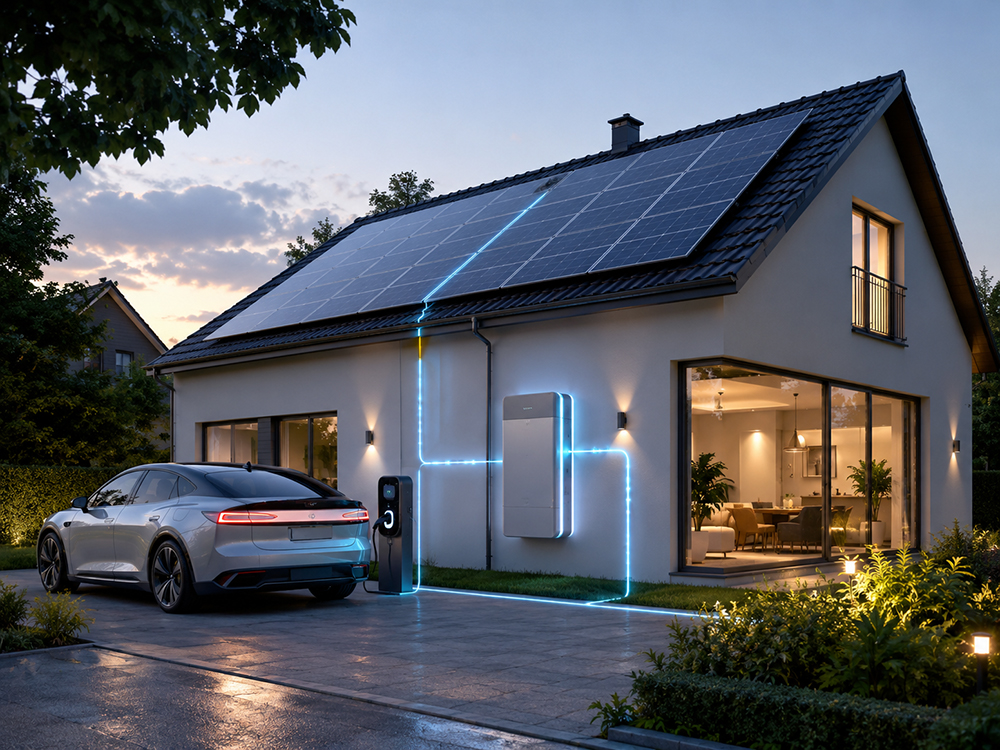
Your car becomes a large backup battery for your home. When summer peak electricity prices surge or an unexpected outage occurs, an electric vehicle can use a bidirectional charger to feed its large DC battery power back into the home, powering air conditioning and lighting and enabling temporary household energy autonomy.
V2G, Vehicle-to-Grid:
This is the ultimate form of collective distributed energy storage. When a city faces peak electricity demand and renewable generation stops, tens of thousands of parked electric vehicles can collectively discharge power back to the urban grid through vehicle networks and earn price differences. When electricity is cheaper late at night, smart charging begins again.
Mobile Grid Concept:
In remote areas or disaster zones, multiple vehicles equipped with high-voltage platforms may even be combined into a temporary microgrid to power critical infrastructure.
This deep integration between vehicle networks and energy networks gives cities an additional dynamic energy buffer made up of millions of EVs when facing extreme weather or grid failures.
Smart Buildings and Home Microgrids: Energy Sovereignty on the Rooftop
The final mile of energy autonomy will ultimately arrive in the spaces where people live every day: smart buildings and homes.
In the past, a household electricity bill was an irreversible bill to be paid. But in 2026, with the spread of Home Energy Management Systems (HEMS) and rooftop solar-plus-storage systems, home microgrids have quietly taken root in advanced communities.
Delta Chief Brand Officer Shan-Shan Guo noted while showcasing physical and edge AI applications: “At this year’s COMPUTEX, we presented AI entering multiple scenarios, including factories, buildings, and transportation.”
Taking smart buildings as an example, systems integrate IoT sensors and physics simulation engines. Before environmental weather changes occur, they can calculate solar radiation and thermal energy in advance, intelligently adjusting shading, air conditioning, and lighting. This can achieve 20% energy savings while maintaining comfort.
A highly technological vision of household energy autonomy is emerging: high-efficiency solar panels on rooftops silently collect sunlight during the day, and the energy flows into storage batteries. At the same time, the home’s HEMS system, combined with proactive prediction through edge AI, automatically instructs smart appliances to operate when sunlight is strongest and electricity is most abundant. When evening peak pricing arrives, the system disconnects from the external grid and instead allows the home storage battery and the EV parked in the garage to jointly supply power.
This intelligent dispatch gives every household a form of energy sovereignty that is no longer constrained by fluctuations in the large power grid.
Energy Platformization: VPPs and New Business Models
When factories, vehicles, and homes all become independent nodes of energy autonomy, a major challenge emerges: how can these thousands or even tens of thousands of fragmented distributed energy resources be integrated to create real commercial value? The answer is the Virtual Power Plant, or VPP, platform.
“AI has not only increased computing demand, but has also fundamentally changed the requirements of data centers and industrial facilities for power, cooling, water resources, and operational management,” emphasized Doug Warren, Global Senior Vice President at AVEVA. Facing the complexity of high-density computing and distributed infrastructure, the industry is introducing industrial intelligence to dynamically integrate data, artificial intelligence, and human expertise.
This has given rise to a new generation of energy business models: Energy-as-a-Service, or EaaS.
Free electricity trading:
Through VPP platforms, homes and factories no longer simply pay electricity bills. They can participate in spot electricity market transactions, releasing their stored green electricity when prices are highest and turning energy into a real asset.
Virtual power plant dispatching:
A VPP can integrate storage batteries from tens of thousands of households and self-generated renewable energy from factories across an entire city through cloud algorithms. Without affecting anyone’s quality of life, tens of thousands of small actions can converge into a massive flow of electricity injected into the grid. Combined with microsecond-level high-voltage protection and real-time energy monitoring provided at the chip level by Infineon and Texas Instruments, energy utilization efficiency can be maximized.
Who Will Become the New Leaders in the Era of Energy Autonomy?
In this energy transformation spanning factories to homes, the new “strategic map” of energy is taking shape. Major players are using their respective strengths to compete for the future throne.
1. Semiconductor companies: providers of chip control and materials
Giants such as Infineon and Texas Instruments have mastered the underlying technologies of three generations of semiconductor materials: Si, SiC, and GaN. Without their power chips capable of handling high-voltage DC, safety isolation, and ultra-high-frequency conversion within microseconds, all microgrids and solid-state power devices would be empty shells unable to operate.
2. Power equipment and system integration leaders: builders of end-to-end infrastructure
Companies such as Schneider Electric, Delta, and MiTAC fall into this category. When launching the new MCDU-70, Rich Whitmore, CEO of Motivair under Schneider Electric, stated: “The success of data centers lies in providing scalable, reliable, and highly efficient infrastructure solutions to support the deployment of next-generation AI factories.”
Their high-voltage DC distribution capabilities and prefabricated modular blueprints serve as the industrial foundation for assembling fragmented green energy resources into resilient microgrids.
3. AI platform and chip leaders: designers of the brain and ecosystem
NVIDIA is a key example. Through its powerful computing ecosystem and digital twin platform, it is working with hardware leaders to define the future operating logic of smart factories and smart cities.
4. New energy and VPP startups
With flexible algorithms and blockchain-based power trading mechanisms, these companies are rapidly entering the last mile of communities, homes, and mobile grids, becoming highly agile strategic players with strong growth potential.
Conclusion
From AI computing factories powered directly by high-voltage DC, to electric vehicles parked in garages and ready to feed power back at any moment, to smart homes that use AI to proactively predict weather and coordinate household appliances from the rooftop, the wave of energy autonomy is reshaping the world in an irreversible way.
The ultimate technological direction of this revolution is no longer simply about who can generate more electricity. Instead, it is about who can use the most precise data and the most efficient semiconductor materials to dispatch every milliampere of current within microseconds.
As electrification, automation, and digitalization become seamlessly integrated into the spaces where people live, human society will officially leave behind the old era of passive dependence on large centralized grids and enter a sustainable future in which every person and every factory can obtain their own energy autonomy.
【Disclaimer】
The content of this article only represents the author's personal views and has nothing to do with Creating.
The content, text description and originality have not been verified by this site. This site does not make any guarantee or commitment to this article and all or part of the content, authenticity, completeness, and timeliness. It is for readers' reference only. Please verify the relevant content yourself.
Creating Nano Technologies, Inc.
59 Alley 21 Lane 279, Chung Cheng Road, Yung Kang City, Tainan, TAIWAN
TEL:886-6-2323927 FAX:886-6-2013306 URL: http://www.creating-nanotech.com