

Why Are DLC Coatings Used on Hair Clipper Blades? Understanding Wear Resistance, Corrosion Protection, and Low Friction
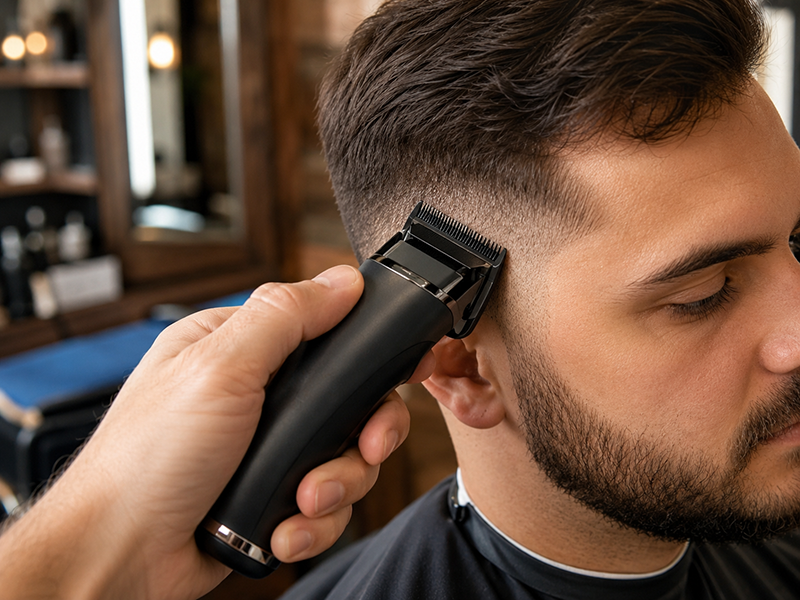
Singapore-based professional hairdressing tool brand TUFT recently launched its VIPER range of clippers and trimmers. One notable feature is the use of diamond-like carbon (DLC) coatings on the blades.
According to a new-product report published by Estetica Export on August 27, 2026, the VIPER range consists of the VIPER-C Professional Clipper and VIPER-T Professional Trimmer. Both models feature brushless motors, DLC-coated blades, and up to 180 minutes of cordless runtime. The VIPER-C operates at 8,000 rpm, while the VIPER-T combines a 7,000 rpm motor with an adjustable T-blade. The two models are designed for tasks ranging from bulk cutting and fading to detailed beard and hairline work. See the Estetica Export product report
TUFT’s official product information highlights rust resistance and precision cutting as key benefits of its DLC-coated blade. This brings a functional thin-film technology more commonly associated with automotive and motorcycle components, molds, and precision mechanisms into grooming tools that consumers may use every day. See TUFT’s official VIPER-C product information
Why Do Hair Clipper Blades Need Low-Friction, Wear-Resistant Surfaces?
Hair clippers typically use two toothed blades that slide back and forth at high speed, cutting the hairs that enter the spaces between the teeth. During operation, the blade assembly is continuously exposed to metal-to-metal contact, repeated friction, localized pressure, and environmental factors associated with hair, sebum, cleaning products, and moisture.
After extended use, wear at the contact surfaces, increased roughness, or dulling of the blade teeth may lead to hair pulling, greater sliding resistance, unusual noise, or uneven cutting. For professional barbers serving multiple clients each day, blade durability and stable sliding performance directly affect handling and productivity.
A DLC coating modifies this critical friction interface without substantially changing the blade’s dimensions or overall structure.
What Is DLC? It Does Not Mean Coating the Blade with Natural Diamond
DLC stands for Diamond-Like Carbon. It is neither natural diamond nor a single fixed formulation. Instead, the term covers a family of functional thin films based primarily on amorphous carbon.
Differences in hydrogen content, carbon-bonding structure, dopants, interlayer design, and deposition method can produce DLC coatings with different hardness levels, friction characteristics, temperature resistance, and surface properties. According to technical information from Oerlikon Balzers, industrial DLC coatings are typically about 1–5 micrometers thick and may have hardness values ranging from 8 to 80 GPa or higher. Actual values depend on the coating type and test conditions. See Oerlikon Balzers’ DLC technical information
Although extremely thin compared with the blade itself, the coating is located at the first point of contact with friction, cutting forces, and the external environment. It can therefore directly influence blade performance.
How Can a Micron-Scale DLC Film Improve Blade Performance?
1. Reducing Sliding Resistance for Smoother Reciprocating Motion
The moving and stationary blades of a clipper must slide rapidly against each other. DLC has low-friction properties that can help reduce sliding resistance at the metal contact surfaces and lower the risk of scratching, material transfer, and irregular movement.
However, a DLC coating does not mean the blade no longer requires lubrication. Blade clearance, spring force, surface roughness, cleanliness, and lubricating oil still affect friction and heat generation. The coating is one protective element that improves the friction interface; it does not replace proper blade design or routine maintenance.
2. Slowing Wear and Helping Maintain Tooth Geometry
Whether a blade cuts hair effectively depends not only on its initial sharpness but also on whether it can retain its tooth geometry, contact position, and sliding clearance after extended use.
DLC’s high hardness and wear resistance can reduce surface loss caused by repeated friction, helping the blade retain its original geometry for longer. However, DLC cannot resharpen an already dull blade. Substrate hardness, edge preparation, and surface treatment before coating remain critical.
3. Providing a Barrier Against Corrosion Caused by Moisture and Cleaning Conditions
Clipper blades frequently come into contact with sweat, moisture, disinfectants, and cleaning products. Chemically stable DLC can serve as a barrier between the metal substrate and the external environment, which is why it is often used to improve surface corrosion resistance.
Yet “rust resistant” does not mean “rustproof.” Research shows that DLC can protect steel under specific conditions, but pinholes, uncovered areas, edge defects, or localized delamination may still create pathways for corrosive media to reach the substrate. Hair and residue should therefore still be removed after use, the blade should be kept dry, and lubrication and maintenance should follow the manufacturer’s instructions. See the DLC corrosion study in Materials; see the study on defects in DLC thin films
4. Improving the Surface Without Significantly Increasing Component Weight
DLC coatings are generally only a few micrometers thick, allowing surface performance to be improved with virtually no meaningful increase in blade weight. This makes the technology suitable for precision components that require rapid reciprocating motion.
However, the operating clearance and edge geometry of clipper blades are extremely fine. Even a micron-scale coating must be considered in dimensional tolerances, edge coverage, and coating-uniformity assessments. Thicker is not necessarily better: excessive internal stress or an unsuitable interlayer design may instead reduce adhesion or cause edge delamination.
A Black Appearance Alone Does Not Prove DLC Blade Performance
DLC-coated blades on the market are often black or dark gray, but color alone cannot verify coating quality. Even when products are all described as DLC-coated, their carbon structures, hardness, coefficients of friction, thicknesses, interlayers, and deposition processes may differ.
Factors that genuinely affect blade service life include:
-
Blade steel and substrate hardness
-
Edge-preparation quality and surface roughness before coating
-
DLC type, thickness, and interlayer structure
-
Coating uniformity at the tips and sides of the blade teeth
-
Internal stress and coating adhesion
-
Clearance, pressure, and operating speed between the moving and stationary blades
-
Cleaning agents, humidity, lubrication, and maintenance methods
-
Hair type and daily operating time
A DLC blade should therefore not be evaluated solely by whether it has a coating or whether the surface looks sufficiently black. Adhesion, hardness, friction and wear, corrosion resistance, and actual cutting-life tests are needed to confirm that the coating suits the blade’s working conditions.
From Hair Clippers to Other Blades and Precision Components
The TUFT VIPER example shows that DLC is no longer limited to racing or heavy-industry components. Razors, industrial blades, food-processing knives, medical instruments, molds, pumps, and precision sliding components may all benefit from DLC where lower friction, reduced adhesion, or longer surface life is required.
Oerlikon Balzers also identifies stainless-steel cutting blades, food-processing equipment, automotive components, mechanical seals, pumps, and valves as established DLC applications. These examples share the same objective: using an extremely thin engineered surface to improve the areas most exposed to friction and wear.
CreatingNano DLC Contract Coating Evaluation
Creating Nano Technologies Inc. provides DLC coating and functional thin-film contract services. Suitable pretreatment methods, interlayer structures, and coating parameters can be evaluated according to component material, edge geometry, surface roughness, operating clearance, speed, cleaning method, and target service life.
For blades and precision components, coating thickness, hardness, adhesion, friction and wear, corrosion resistance, and actual service-life testing should be completed before implementation. These tests help confirm that the coating will not adversely affect the cutting edge, dimensional tolerances, or final-use safety.
Sources
-
Estetica Export: TUFT VIPER—Power and Precision for Modern Barbering
-
Oerlikon Balzers: DLC Coatings and Other Carbon-Based Coatings
-
Maerten et al.: Micrometric Growth Defects of DLC Thin Films
Creating Nano Technologies, Inc.
59 Alley 21 Lane 279, Chung Cheng Road, Yung Kang City, Tainan, TAIWAN
TEL:886-6-2323927 FAX:886-6-2013306 URL: http://www.creating-nanotech.com