

How Can AI Support Plasma Process Development? From Simulation to Experimental Validation
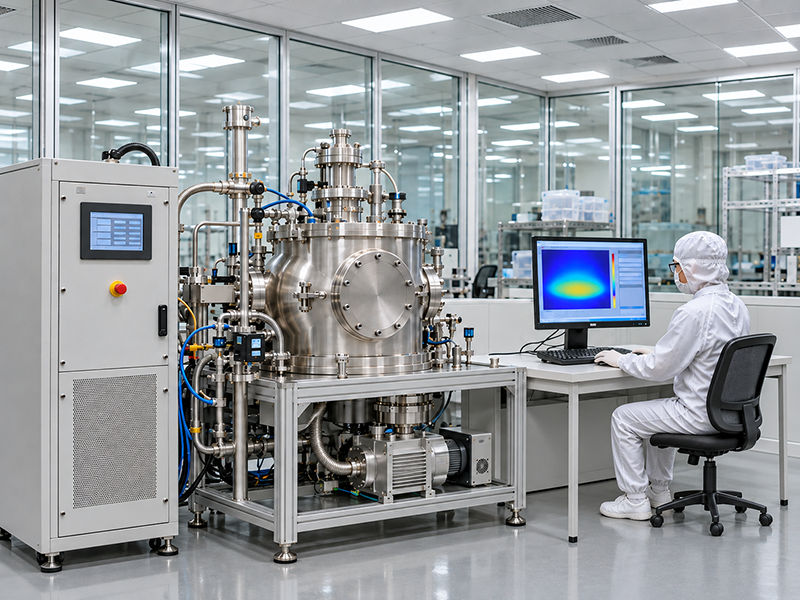
How will plasma respond when gas ratios, power or chamber conditions change? This is a question engineers frequently need to evaluate when developing semiconductor cleaning, etching and thin-film deposition processes.
In a recent article on semiconductor technology, NVIDIA discussed applications of GPU-accelerated simulation, physics AI and digital twins. According to its official announcement, Lam Research has demonstrated the use of PhysicsNeMo to help predict plasma behavior. In a specific case, predictions can be generated in milliseconds, while a full simulation may take days.
These figures apply to specific models and computational workloads. They cannot be directly translated into the processing speed of plasma equipment. From a process development perspective, the key opportunity is that engineers may be able to compare candidate conditions more quickly before scheduling physical tests.
What Can AI Do for Plasma Process Development?
Plasma behavior involves electromagnetic fields, gas flow, chemical reactions and temperature, among other factors. Building a physical model requires selecting appropriate equations, reaction data and boundary conditions to describe the phenomena of interest.
GPU-accelerated simulation can complete physics calculations more quickly. Physics AI can combine physical knowledge with simulation and observational data to build surrogate models for rapid prediction.
For engineers, these tools can help compare parameter changes, examine differences in spatial distributions or screen conditions for further testing. The results a model can predict still depend on its design and the range of data it covers.
Why Do Predictions Still Need Experimental Validation?
AI models have a defined range of applicability. When input conditions differ substantially from the training data, a model may produce a result with significant errors.
Plasma models also need to be checked against actual equipment. COMSOL’s argon/oxygen plasma reactor example notes that simplified reaction data may need to be adjusted, or additional reactions included, to support experimental validation.
When evaluating predictions, engineers should therefore confirm whether the data cover the target conditions, whether model errors are acceptable and whether actual workpieces meet process requirements.
How Can Plasma Simulation Be Connected to Physical Testing?
Drawing on the technical information above, process development can be planned around four steps:
-
Define the objective: Identify whether the goal is to improve surface residue removal, wettability, etch uniformity or thin-film quality, and establish how acceptance will be assessed.
-
Document the conditions: Record the gases, power, pressure, treatment time and workpiece arrangement. If a model is used, also confirm its range of applicability.
-
Plan comparisons: Test candidate conditions using the actual materials, retain baseline samples and compare different positions and batches as needed.
-
Feed back the results: Examine differences between predictions and measurements, then adjust the model, parameters or equipment configuration while continuing to assess repeatability.
Different processes also require different validation priorities:
For plasma cleaning and surface activation, physical validation should focus on surface residues, wettability and subsequent adhesion performance.
For plasma etching, key validation priorities include etch rate, uniformity and feature profiles.
For PECVD thin-film deposition, validation should assess film thickness, uniformity and the film properties required for the intended application.
These are engineering evaluation priorities organized by process objective. Specific test items and acceptance criteria should be established according to the material and intended application.
Evaluating Plasma Equipment: Align Requirements with Validation Methods
For companies evaluating a plasma cleaner, low-pressure plasma equipment or a PECVD system, clear process objectives and measured data can help determine whether the equipment meets their needs.
CreatingNano’s publicly listed products include atmospheric-pressure plasma equipment, low-pressure plasma cleaning and etching equipment, and PVD and PECVD vacuum coating systems. Before discussing plasma surface treatment requirements with CreatingNano, companies can prepare information on their materials, the problems they want to address, existing conditions and acceptance methods to support discussions about equipment and testing.
AI and simulation tools can make the exploration of process conditions more efficient, while physical measurements provide the basis for assessing treatment results. Connecting these two stages helps engineers progressively establish process conditions suited to the actual materials and equipment.
Explore CreatingNano equipment: Low-Pressure Plasma Equipment | Vacuum Coating Systems
References
-
NVIDIA Blog: AI Is Changing How Semiconductor Fabs Work — and Engineers Are Moving Faster Because of It, November 3, 2026. A recent overview of semiconductor technology applications.
-
NVIDIA Newsroom: NVIDIA and Semiconductor Leaders Advance AI Across Chip Design and Manufacturing for AI-Defined Fabs, October 14, 2026. Official announcement covering plasma prediction and semiconductor simulation examples.
-
NVIDIA Developer: PhysicsNeMo Overview and Uncertainty Quantification.
-
COMSOL: Model of an Argon/Oxygen Inductively Coupled Plasma Reactor. Technical reference on plasma reaction modeling and experimental validation.
Creating Nano Technologies, Inc.
59 Alley 21 Lane 279, Chung Cheng Road, Yung Kang City, Tainan, TAIWAN
TEL:886-6-2323927 FAX:886-6-2013306 URL: http://www.creating-nanotech.com