

Solar Thin-Film Equipment Acceptance: Throughput, Continuous Operation, and Film Quality
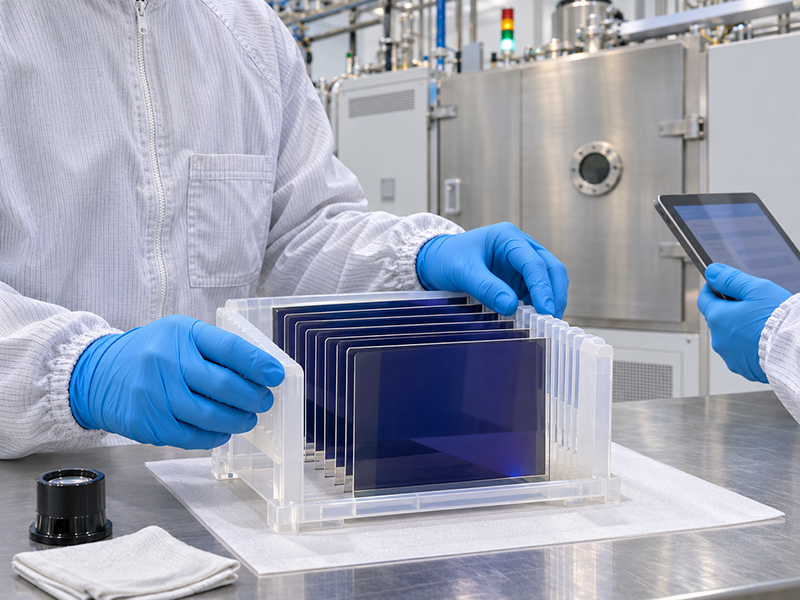
Acceptance testing for PVD and PECVD equipment should verify output, operating stability, and film quality under agreed conditions. Clear methods and traceable records help buyers compare equipment and plan production.
1. Define Throughput Clearly
Confirm substrate size, full or half wafers where applicable, single- or double-sided processing, target thickness, and the process steps included. State whether a figure covers one tool, one line, or multiple lines.
Distinguish rated capacity, measured output, conforming output, and annual production estimates. A useful comparison measure is:
Conforming output per unit time = Number of conforming substrates ÷ Agreed total test time.
Specify how loading, pump-down, cleaning, batch changes, and downtime are counted.
2. Check Continuous Operation
Agree on the recipe, load, warm-up period, test duration, and permitted interruptions. Record alarms, manual interventions, downtime, and recovery.
Sample at the beginning, middle, and end of the run to track quality changes. SEMI E10 and E79 can provide a framework for equipment performance metrics where both parties agree to use them.
3. Verify Film Quality
Select acceptance criteria according to the film’s function and device structure.
| Quality Area | Key Checks |
| Thickness and uniformity | Target thickness, measurement locations, and variation within and between substrates and batches |
| Optical performance | Transmittance, reflectance, or optical constants over specified wavelengths |
| Electrical and interface properties | Sheet resistance or passivation-related measurements, as applicable |
| Defects | Agreed inspection methods and limits for particles, pinholes, or peeling |
Document measurement methods, sample quantities, edge exclusions, and uniformity calculations. Transparent conductive films require both optical and electrical evaluation; subsequent deposition steps may also affect underlying passivation layers.
4. Connect Factory and Site Acceptance
Factory Acceptance Testing (FAT) can cover equipment functions, controls, safety interlocks, and agreed sample results. Site Acceptance Testing (SAT) should confirm operation with the actual power, gases, cooling, vacuum, exhaust, and upstream/downstream interfaces.
Evaluate completed-cell performance separately using appropriate photovoltaic measurements, such as the I–V procedures covered by IEC 60904-1. Keep substrate, recipe, equipment, and measurement records traceable.
5. Compare Resource Use
Under equivalent process and quality conditions, consider:
Energy per conforming substrate = Energy consumed within the agreed system boundary ÷ Number of conforming substrates.
Define whether pumps, cooling, standby, cleaning, and maintenance are included. Gas, water, and consumables can also be tracked. Quantified carbon-reduction claims require consistent boundaries, emission factors, and a comparison baseline.
6. Start an Equipment Discussion with Creating Nano
Creating Nano Technologies Inc. lists PVD, PECVD, combined systems, and custom design services. Its CF-SP01 high-vacuum sputtering system includes solar-industry applications among its publicly stated uses.
Provide substrate details, film function, target thickness, throughput requirements, site conditions, and proposed acceptance criteria to discuss a suitable configuration.
Explore vacuum coating systems|View CF-SP01
Creating Nano Technologies, Inc.
59 Alley 21 Lane 279, Chung Cheng Road, Yung Kang City, Tainan, TAIWAN
TEL:886-6-2323927 FAX:886-6-2013306 URL: http://www.creating-nanotech.com