

Sensing, Thermal Management, and Integration Take Their Places as Taiwanese Companies Fill Gaps in Automotive Subsystems at the TADA Pavilion
Micro Electronics
July 7, 2026
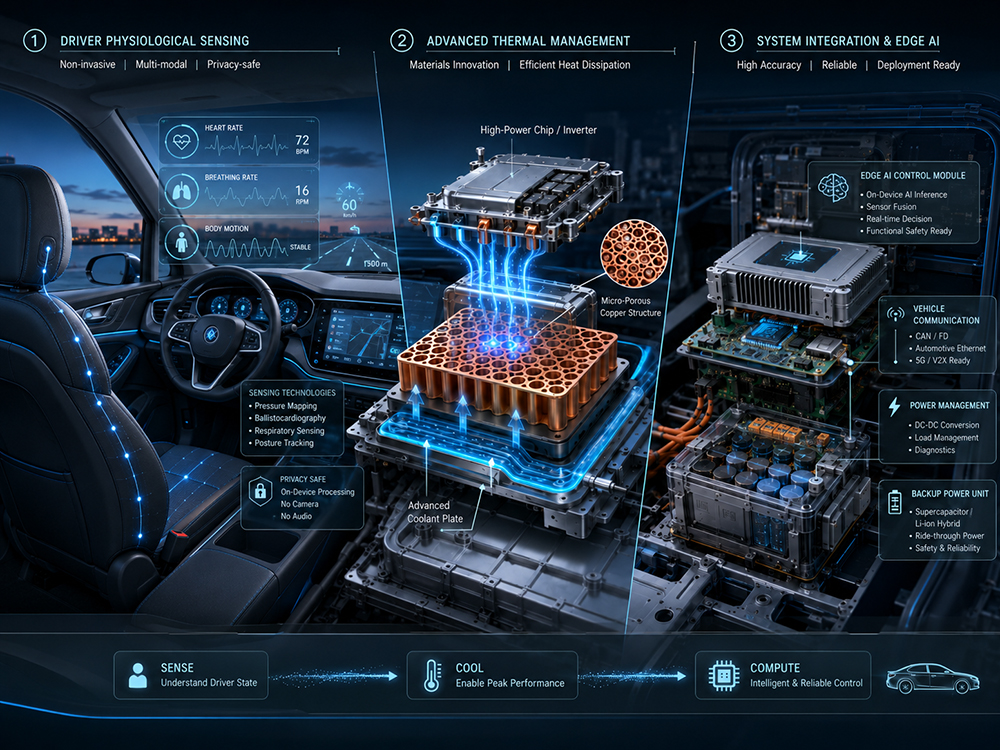
At the 2026 Computex themed pavilion hosted by the Taiwan Advanced Automotive Technology Development Association (TADA), three companies with very different positions appeared side by side: Hui Jia Health, which focuses on fiber-optic physiological sensing; Japanese startup Lotus Thermal Solution, which specializes in porous metal thermal materials; and System Electronics, which began in automotive electronics and has since moved toward system integration.
Investment in automotive electronics has long focused on external vehicle perception. However, as vehicle systems become increasingly complex, another set of gaps is emerging: monitoring the driver’s in-cabin condition, managing heat from power modules, and ensuring that solutions can actually be implemented at customer sites. Each of these three companies addresses one of those gaps.
The Missing Link Inside the Cabin: From External Perception to Driver Physiology
External perception technologies have become relatively mature, but today’s automotive sensing systems still have limited ability to continuously monitor the physiological condition of the driver. In-cabin cameras involve continuous image capture, making privacy concerns difficult to avoid. Wearable devices, meanwhile, cannot ensure that the driver will wear them throughout the entire trip.
This is the gap Hui Jia Health is targeting. The company’s self-developed nFOPT, or non-invasive fiber-optic physiological monitoring technology, embeds optical fibers directly inside seat cushions or steering wheels. By using the high sensitivity of optical fibers to subtle disturbances, the system can continuously detect heartbeat, respiration, and body movement without requiring the driver to wear any device. Physiological parameters are then derived by analyzing differences in optical signals.
According to Hui Jia Health General Manager Yu-Yu Chiang, these values can be combined with AI models to serve as auxiliary indicators for fatigue driving or sudden physical discomfort. He also noted that physiological signals and driving status do not have a simple one-to-one causal relationship. Drunk driving or heart-related discomfort, for example, cannot be determined directly from heart rate alone. Multiple indicators must still be considered, and clinical studies and field validation are required before the technology can be deployed in real-world scenarios. Originally applied in medical care, the company’s accumulated experience in monitoring and anomaly detection has become the foundation for its expansion into the smart mobility market.
From Lotus-Root Structures to EV Cooling: Cross-Field Migration of Materials Technology
As the power density of AI chips continues to rise, thermal design pressure in data centers is also increasing. At the same time, heat generation from electric vehicle inverters and power modules is growing rapidly, with some automakers already planning for cooling requirements at the 500-watt level.
Lotus Thermal Solution focuses on the material itself. This Japanese startup, originating from research at Osaka University, has developed a core technology that forms a large number of parallel micro-pores inside copper materials. Because the cross-section resembles a lotus root, the structure is called the Lotus structure. The numerous pores significantly increase the metal’s heat exchange area, allowing heat to be transferred more efficiently to the cooling medium. The structure can also be applied to next-generation thermal management components such as vapor chambers, improving evaporation and condensation efficiency.
The application showcased this time was a two-phase immersion cooling solution paired with an NVIDIA GPU. In this system, the Lotus porous structure acts as a boiling enhancer, increasing the density of vaporization nucleation sites on the chip surface. Company president Takuya Ide acknowledged that automotive certification cycles are long. For now, the company is prioritizing the establishment of proven results in AI server applications before gradually expanding into the automotive market, while actively collaborating with Taiwan’s server supply chain.
System Electronics is addressing not the question of whether the technology exists, but whether it can actually be deployed at customer sites. Founded in 1977, the company shifted from keyboard manufacturing to automotive electronics, with tire pressure monitoring systems (TPMS) remaining one of its long-standing products. Its accumulated capabilities in ruggedized design and manufacturing integration have enabled it to expand into an automotive mobility business unit, using Qualcomm platforms to enter edge AI image recognition and drone ground control stations.
Wang Sheng-Hsien, Deputy Director of the Automotive Mobility Business Unit, pointed out that building the hardware is not the hardest part. The real challenge is implementing the solution in the customer’s actual environment. Requirements vary widely, customization takes time, and most customers immediately ask for accuracy above 99.98%. System Electronics starts from board-level design based on customer needs and, when necessary, can extend from board development and mold design all the way to SMT surface-mount assembly. The company chose Qualcomm rather than NVIDIA or Intel because low power consumption and compact size are more critical for edge devices.
Power supply is handled by its subsidiary Power Tank. Since 2018, Power Tank has supplied lithium battery modules for uninterruptible power supply (UPS) systems to a major semiconductor manufacturer. More recently, it has also entered the battery backup unit (BBU) product segment, addressing the ORV3 (Open Rack V3) open rack architecture commonly adopted in AI data centers. Wang noted that the edge AI image recognition integration capabilities of System Electronics and the energy management modules of Power Tank both have opportunities to extend into automotive scenarios in the future, gradually expanding System Electronics’ product line within the automotive ecosystem.
Looking at these three companies, the TADA pavilion reflects the current situation in which different players are entering three key automotive subsystems: sensing, thermal management, and system integration. Their progress toward commercialization varies. System Electronics’ TPMS products and Power Tank’s UPS business are already in operation, Hui Jia Health’s fiber-optic sensing technology is still undergoing clinical validation, and Lotus is still building proven results in server applications before expanding into the automotive market. The significance of the TADA pavilion lies in bringing solutions at different levels of maturity into the same field.
【Disclaimer】
The content of this article represents only the personal views of the author and is not related to Creating Nano Technologies, Inc.
The accuracy, wording, and originality of the content have not been verified by this website. This website makes no guarantees or commitments regarding the truthfulness, completeness, or timeliness of this article, in whole or in part. The content is provided for reference only. Readers are advised to independently verify the relevant information.
Creating Nano Technologies, Inc.
59 Alley 21 Lane 279, Chung Cheng Road, Yung Kang City, Tainan, TAIWAN
TEL:886-6-2323927 FAX:886-6-2013306 URL: http://www.creating-nanotech.com