

230°C High-Heat-Resistant Epoxy Encapsulation Material Expands Applications for SiC Power Modules
Materialnet
July 14, 2026
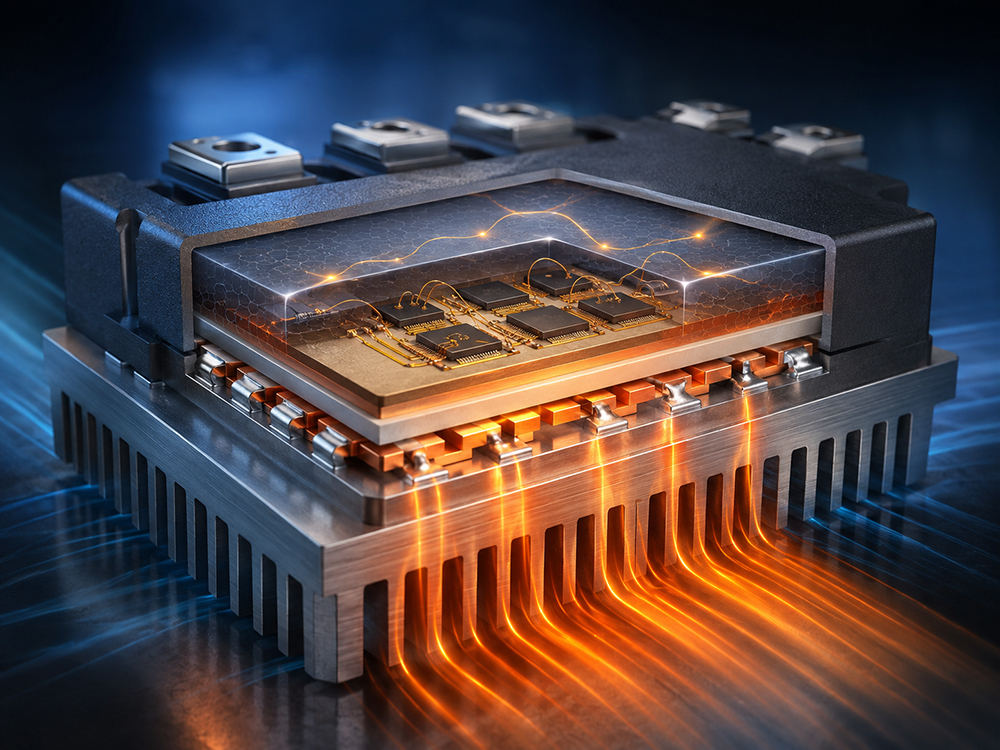
Japan’s Sumitomo Bakelite has developed a solid epoxy resin encapsulation material, the EME-G785 series, for next-generation silicon carbide(SiC)power modules, and has officially begun mass production. This material achieves an industry-first high glass transition temperature(Tg)of 230°C, meeting the stringent requirements for power semiconductor encapsulation materials used in high-temperature operating environments. Although SiC semiconductors can operate at temperatures above 200°C, the encapsulation materials used to protect semiconductor components still face challenges in heat resistance, making this a key issue in the development of next-generation power modules.
In general, increasing the glass transition temperature of epoxy resin tends to raise the material’s elastic modulus. During thermal cycling, this can easily generate internal stress, leading to delamination between the chip and substrate, or cracking within the resin itself. As a result, although high-Tg materials have been achievable in the past, applying them to actual products has remained difficult.
To solve this problem, Sumitomo Bakelite adopted its latest low-stress technology. By adjusting the main-chain structure of the resin and optimizing crosslinking density, the company successfully developed the EME-G785 series, which improves heat resistance while suppressing increases in elastic modulus. The new material achieves a glass transition temperature of 230°C, representing one of the highest levels among epoxy resin encapsulation materials. It can also maintain excellent physical properties under high-temperature operating conditions, ensuring the insulation reliability required for long-term operation of SiC power modules.
The EME-G785 series offers excellent heat resistance and is suitable for sintering materials as well as solder bonding processes used to connect with heat sinks, helping improve the thermal performance of power modules. By enhancing heat dissipation efficiency, it can further increase power density, enabling power modules to move toward smaller size and higher output. This meets the growing demand for high-efficiency power control components in electric vehicles, high-power electronic equipment, and energy systems.
Related Link: https://www.materialsnet.com.tw/DocView.aspx?id=57036
【Disclaimer】
The content of this article only represents the author's personal views and has nothing to do with Creating.
The content, text description and originality have not been verified by this site. This site does not make any guarantee or commitment to this article and all or part of the content, authenticity, completeness, and timeliness. It is for readers' reference only. Please verify the relevant content yourself.
Creating Nano Technologies, Inc.
59 Alley 21 Lane 279, Chung Cheng Road, Yung Kang City, Tainan, TAIWAN
TEL:886-6-2323927 FAX:886-6-2013306 URL: http://www.creating-nanotech.com