

Why Do Advanced Chips Consume So Much Ultra-Pure Hydrogen Peroxide? Understanding Trace Contamination Control through Wet Cleaning
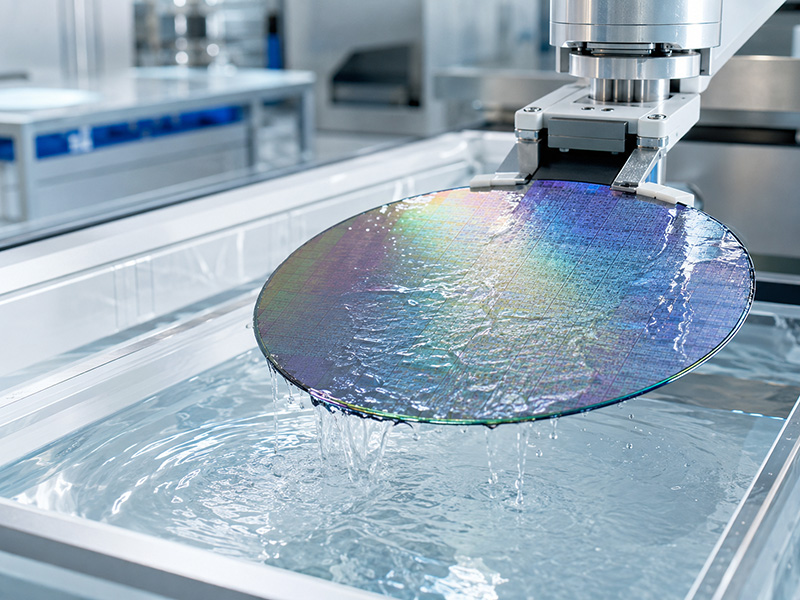
In September 2026, Solvay announced plans to expand its annual production capacity for electronic-grade ultra-pure hydrogen peroxide in Tainan from 35,000 metric tons to more than 70,000 metric tons by the end of 2026. This investment reflects the growing demand for high-purity cleaning chemicals in advanced semiconductor manufacturing.
What Role Does Hydrogen Peroxide Play in Wafer Cleaning?
After etching, deposition, and photoresist processes, wafer surfaces may retain particles, organic residues, metal ions, and reaction by-products. Even trace contamination can affect coating adhesion, circuit integrity, and device reliability.
Electronic-grade hydrogen peroxide is an oxidizing agent commonly combined with ammonia, hydrochloric acid, or sulfuric acid in different cleaning solutions:
- SC-1: Removes particles and some organic contaminants
- SC-2: Reduces metallic contamination
- SPM: Breaks down photoresist and organic residues
Why Must It Be Ultra-Pure?
Industrial-grade hydrogen peroxide may contain trace metals and other impurities that could become new sources of wafer contamination. Electronic-grade chemicals therefore require strict control over purity, storage, and delivery systems to prevent secondary contamination during cleaning.
As circuit dimensions shrink, 3D structures become more complex, and process steps increase, wafers require more surface-treatment cycles with tighter requirements for cleanliness and uniformity.
Wet Cleaning and Plasma Cleaning Work Together
Wet cleaning is suitable for removing particles, metals, and organic contamination across large areas. Dry plasma processes can remove specific residues, activate surfaces, and improve subsequent coating or bonding performance.
The two technologies are complementary and should be selected according to the substrate, contaminant type, and process requirements.
Creating Nano Technologies Inc. provides plasma cleaning and surface-treatment equipment. Plasma parameters and automated production-line integration can be evaluated according to substrate materials, contaminants, cleanliness targets, and process-uniformity requirements.
Sources
- Reuters: Solvay to expand Taiwan chip-grade hydrogen peroxide capacity
- Lam Research: Wafer strip and clean technologies
- Evonik: Hydrogen peroxide applications in semiconductor manufacturing
- UC Merced: Wafer wet-cleaning procedures
Creating Nano Technologies, Inc.
59 Alley 21 Lane 279, Chung Cheng Road, Yung Kang City, Tainan, TAIWAN
TEL:886-6-2323927 FAX:886-6-2013306 URL: http://www.creating-nanotech.com